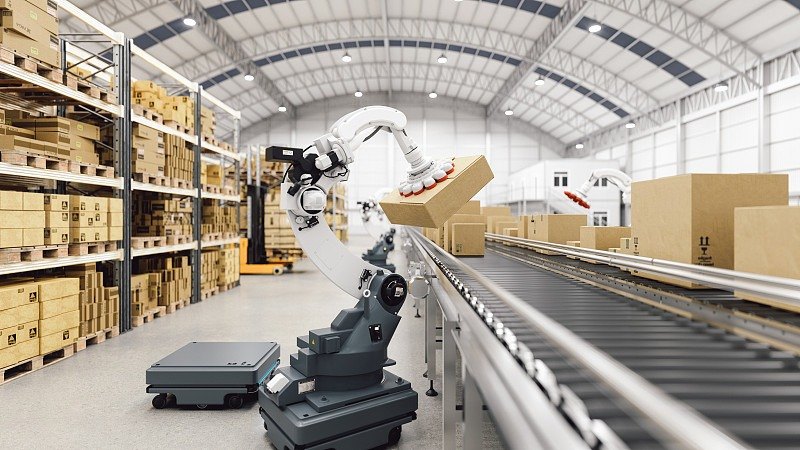
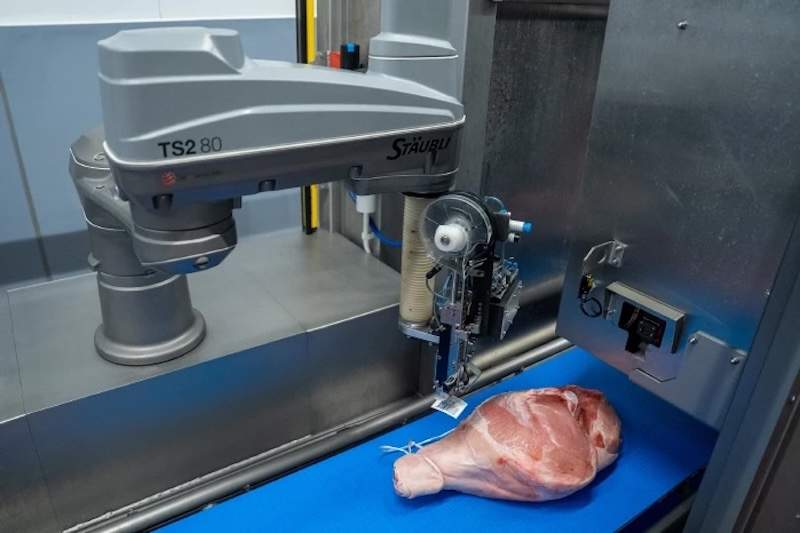
en.Wedoany.com Reported - Spanish system integrator Timpolot has developed an AI-based robotic system for automatically labeling Serrano ham. The system can complete up to 900 label injection processes per hour, executed by a Stäubli SCARA robot specifically designed for the food industry.
Serrano ham requires 10 to 18 months of air-drying and curing before consumption, involving multiple steps. Although the labeling process is small, it is crucial for marking the week, year, and batch number, essential for early production stages. A medium-sized producer can process over 5,000 hams daily.
Previously, this labeling task could only be done manually. Due to the varying bone positions in each natural ham, with bones accounting for 30% to 40% of the total weight, robots could not detect bone locations, and labeling tools could not penetrate bones. Operators relied on experience to select labeling points for each ham.
Jordi Bassols, founder and general manager of Timpolot, explained that hams are randomly placed on the conveyor belt by workers. A vision system identifies the position of each ham and uses AI to determine the optimal labeling point while avoiding bones. After a printer generates a plastic label, a robot equipped with a standard pneumatic fastener applicator picks up the label and injects the needle into the ham based on coordinates provided by the camera.
The production line is operated by a large-scale Serrano ham producer with high output. The Stäubli SCARA robot TS2-80 HE processes 150,000 to 180,000 kg of ham per day at a continuous speed of 750 pieces per hour, with a peak speed of 900 pieces per hour and a cycle time of just 4 seconds. The robot's potential speed is faster, but label printing and upstream processes limit the overall cycle time.
Jordi Bassols stated that automating this task has improved work quality, reduced sick leave, and allowed operators to focus on higher-value tasks. Additionally, centralizing all IT management into one node has enabled better traceability control.
The HE version of the Stäubli TS2 series chosen by Timpolot is designed for the food industry, with a smooth surface and a housing that withstands industrial cleaners and medium-pressure water washing, using food-grade H1 lubricant. Bassols added that hygiene is key in food industry processes, and Stäubli ensures the reliability and food safety required by customers. Furthermore, the choice of Stäubli robots was based on the ease of programming with the VAL3 system and the long-term mechanical reliability provided by oil-immersed gear reducers. Seamless integration with PLCs was achieved through connectivity via multiple industrial protocols.
In terms of data and IT architecture, the camera connects to a PC running Timpolot-developed software for image processing and AI-based analysis. Coordinates are sent to an Omron NX1P2 PLC, which transmits them to the robot via Ethernet/IP and manages peripheral devices. Jordi Bassols noted that since hams are irregular objects, the algorithm uses traditional vision functions, while the integrated AI more precisely determines labeling points and predicts bone positions, preventing needle breakage during fastener injection.
The production line has been running for several months. Jordi Bassols stated that in the meat industry, no two products are identical, and the robot must communicate smoothly with peripheral devices to adapt to changes. The system ensures labeling quality, with all labels placed in the same position on each ham, while guaranteeing reliable product traceability. Josep M. Serra, Robotics Director at Stäubli Spain, commented that this is a high-end automation system adapted to high hygiene requirements, handling personalized products, and integrating AI with custom programming, and looks forward to new projects with Timpolot.