en.Wedoany.com Reported - After years of material screening and engineering validation, tungsten has become the mainstream choice for divertor design in current international magnetic confinement fusion devices.
This article reviews the development history of plasma-facing materials for fusion, analyzes why carbon materials once dominated for a long period and then gradually phased out, and explains why tungsten has become the preferred option for major international fusion devices.
From the 1980s to the 1990s, carbon-based materials were widely used in magnetic confinement fusion. Devices such as the Joint European Torus (JET), the Tokamak Fusion Test Reactor (TFTR) in the United States, and Japan's JT-60U extensively employed graphite or carbon fiber composites as the primary materials for plasma-facing components. Carbon materials offer excellent thermal shock resistance and low atomic number advantages, performing prominently under early experimental conditions. However, when fusion research entered the deuterium-tritium (D-T) fuel reactor phase, carbon materials faced severe challenges related to fuel retention. Under plasma bombardment, carbon materials undergo chemical sputtering to form hydrocarbons, which embed large amounts of deuterium and tritium fuel during deposition. Experimental results from devices such as JET and DIII-D indicate that co-deposition is one of the main sources of tritium retention, with fuel retention levels far exceeding the permissible range for future fusion reactors. With the proposal of ITER and future fusion power plants, material evaluation criteria shifted from serving experimental physics to serving energy engineering. Tritium inventory control, fuel cycle sustainability, material lifetime, and safety regulation became new key indicators, leading to the gradual phase-out of carbon materials from the mainstream.
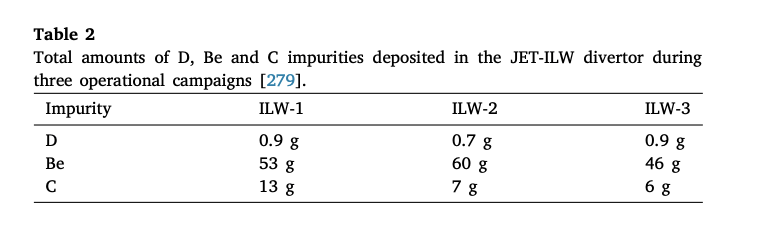
In 2011, JET in the United Kingdom completed a milestone upgrade, replacing all internal carbon walls with an ITER-Like Wall (ILW) consisting of a beryllium first wall and a tungsten divertor. This marked the first systematic validation of the ITER metal wall scheme on a large tokamak device by the international fusion community. Experimental results showed that compared to the carbon wall period, co-deposition was significantly reduced after the metal wall replacement, with fuel retention levels decreasing by approximately one order of magnitude, achieving reductions of 10 to 20 times under certain operating conditions. These results fully demonstrate that metal plasma-facing materials can significantly reduce tritium inventory, providing important experimental evidence for establishing a sustainable fuel cycle system in future fusion power plants. However, JET ILW experiments also revealed new operational challenges brought by metal walls, including an initial decline in plasma energy confinement performance and issues with high-Z impurity control. Tungsten is a typical high atomic number (high-Z) material. Once a small amount of tungsten impurities enters the core plasma, its radiation losses are far higher than those of low-Z elements, and the tungsten impurity concentration in the core region typically needs to be controlled at the ppm level or even lower. Overall, the JET ILW experiments demonstrated the engineering feasibility of a metal wall-based reactor material system.
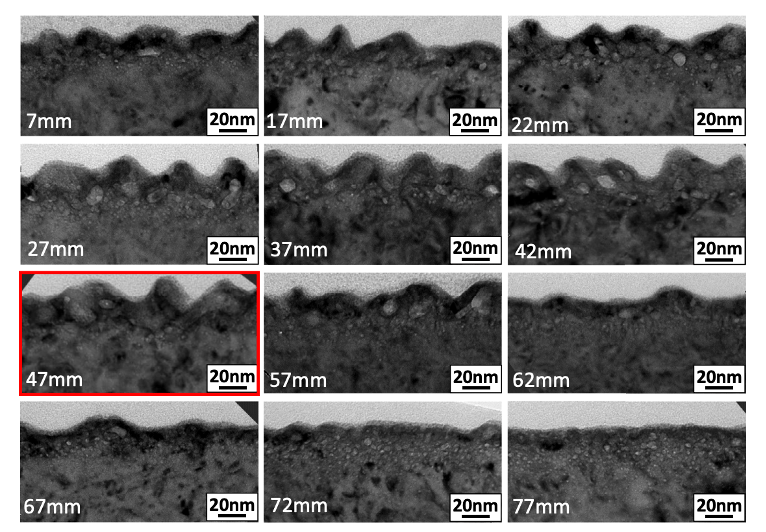
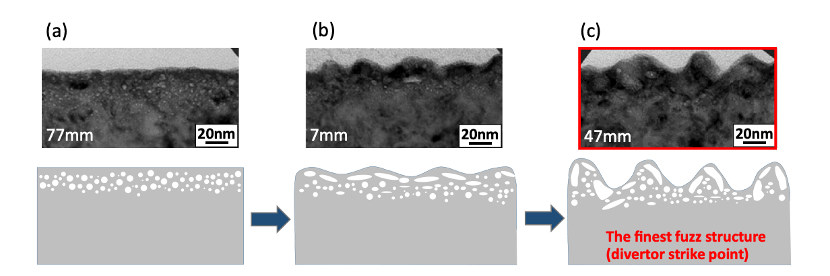
Tungsten has become the current mainstream solution due to its balanced comprehensive performance. Tungsten has a melting point as high as 3695 K and, with efficient active cooling structures, can withstand steady-state heat loads on the order of 10 to 20 MW/m². Tungsten has a relatively high physical sputtering threshold, resulting in lower material erosion rates, and does not undergo significant chemical sputtering like carbon, which leads to large-scale fuel embedding. The overall hydrogen isotope retention level is significantly lower than that of carbon materials. However, tungsten is not an ideal material and still faces issues of high-temperature embrittlement and recrystallization. Long-term high-temperature operation (typically above 1200 to 1300 degrees Celsius) can cause tungsten to recrystallize, increasing brittleness. Under continuous helium ion bombardment, when the material temperature is in the range of approximately 900 to 2000 Kelvin, a nanofiber-like structure known as tungsten fuzz (W-fuzz) may form on the tungsten surface. These structures can detach to form metal dust and affect heat transfer characteristics. Currently, the international fusion community believes that relying solely on material performance improvements is insufficient to fundamentally solve the heat exhaust problem of future fusion reactors. Future breakthroughs are more likely to come from the coordinated development of materials, divertor structural design, magnetic configuration optimization, and operational control.
Currently, most commercial magnetic confinement fusion companies continue to adopt tungsten as the divertor material in their publicly disclosed designs, including China Fusion Company, Fusion New Energy, CFS, Tokamak Energy, and Type One Energy. As of now, no mainstream magnetic confinement fusion company has proposed a mature solid plasma-facing material solution that can fully replace tungsten. Looking back at the development history, the evolution of divertor materials has not been about continuously finding materials with stronger performance, but rather about continuously seeking engineering solutions that better meet the operational requirements of fusion reactors. The transition from carbon to tungsten reflects the shift in fusion research evaluation criteria from experimental physics to energy engineering. As solid materials gradually approach their heat load limits, the fusion community is turning its attention to new directions such as advanced divertor configurations, active heat flux control, and liquid plasma-facing materials.