en.Wedoany.com Reported - On July 9, Mitsubishi Motors signed a memorandum of understanding with Highlanders, a startup from the University of Tokyo, to jointly develop humanoid robots for automotive manufacturing sites and utilize idle facilities at its Kyoto plant to advance mass production. The two parties will study starting production in early 2027, with actual operations beginning in the second half of 2027, ultimately increasing monthly production capacity to 1,000 units. The robots will first be deployed in Mitsubishi Motors' own factories, with potential future sales to external customers.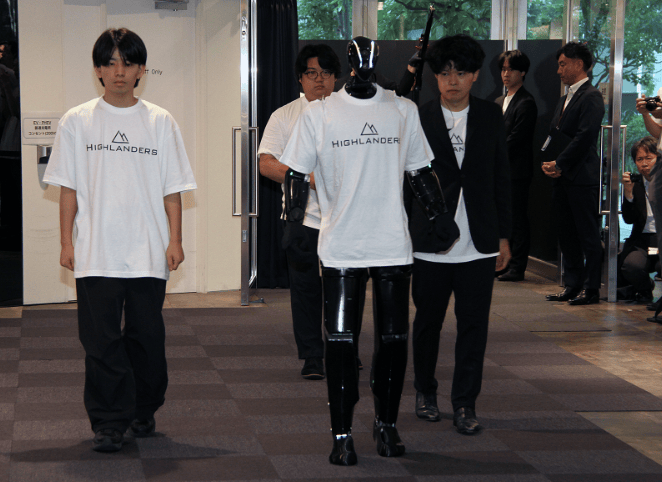
Founded in 2023, Highlanders primarily develops general-purpose humanoid robots, quadruped robots, and robot simulation systems. The launch event showcased the fourth-generation humanoid robot "N" and a quadruped robot, with the name "N" derived from the Roman numeral "IV." Mitsubishi Motors has already invested in Highlanders and plans to continue additional investments, integrating the startup's robotics and physical AI R&D capabilities into its automotive manufacturing system.
The challenge of moving humanoid robots from prototypes to thousand-unit production goes beyond expanding assembly space. Joint actuators, reducers, sensors, controllers, batteries, and structural components require a stable supply chain, and each robot must undergo tests for motion accuracy, load capacity, fall protection, continuous operation, and safety shutdown. Mitsubishi Motors will apply its expertise in mass production design, quality assurance, durability and safety design, mechatronic control, and factory operations accumulated in automotive manufacturing to robot production, transforming robot hardware from repeatedly debugged R&D products into standardized, consistently deliverable industrial products.
The Kyoto plant currently primarily handles engine production, with robot manufacturing equipment to be installed in idle areas, and engine assembly lines also listed as candidate production spaces. Mitsubishi Motors will not immediately reach a monthly output of 1,000 units at the start of production but plans to begin with dozens of units, gradually expanding to hundreds based on usage results in its own factories, before achieving higher capacity. Operational data, fault information, and human-robot collaboration records generated by robots on real production lines will also be fed back to Highlanders for adjustments to mechanical structures, control algorithms, and task execution capabilities.
This collaboration links robot R&D, automotive factory validation, and large-scale manufacturing in a single chain. Mitsubishi Motors can first test the stability of robots in long-term operations as a user, then improve assembly, inspection, and quality control as a manufacturer; Highlanders gains access to mass production facilities and real industrial scenarios. Whether the monthly target of 1,000 units can be achieved will depend on the robots' task completion rate in factories, per-unit manufacturing costs, core component supply, and maintenance efficiency.