en.Wedoany.com Reported - SK Hynix, in collaboration with TetraMem and the University of Southern California, has developed a memristor-based in-memory computing SoC designed to enhance the energy efficiency of neural network inference in edge AI devices. This chip targets lightweight models and utilizes an embedded RISC-V processor for task scheduling.
A memristor is a non-volatile device whose resistance state can change and be retained based on historical current or voltage variations, enabling simultaneous storage and computation. In AI chips, memristors are commonly used to form crossbar arrays that directly store neural network weights, making them suitable for low-power inference, edge computing, and novel in-memory computing architectures. In-memory computing performs partial computations directly within the memory array, avoiding repeated data transfers between the processor and memory, thereby reducing latency and power consumption. This approach is often applied in neural network matrix multiplication, convolutional inference, and edge AI accelerators.
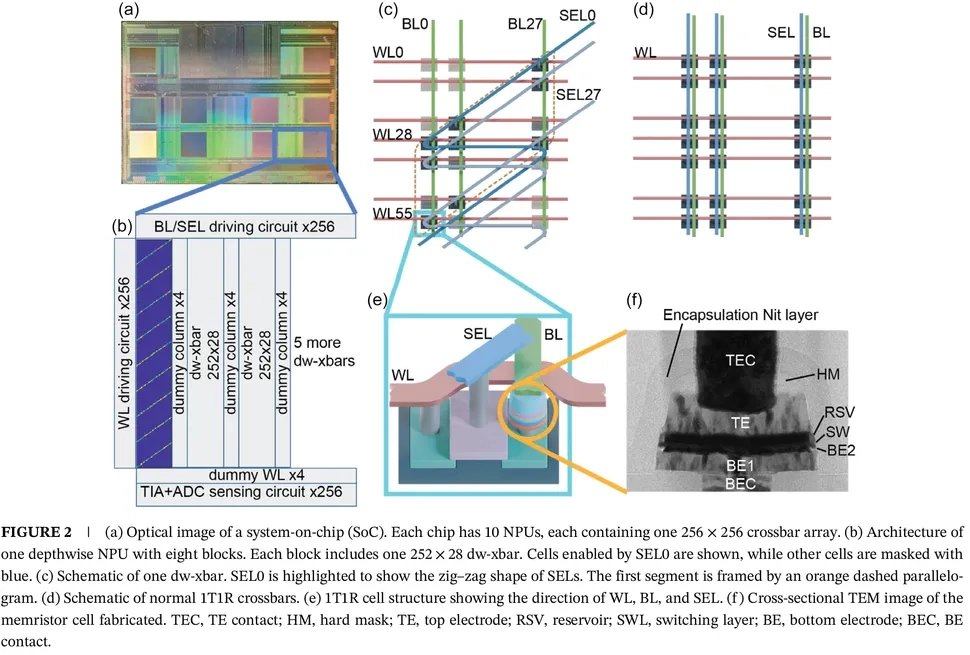
The SoC integrates 10 neural processing units (NPUs), with a theoretical peak total computing power of approximately 2.54 TOPS. One NPU is dedicated to depthwise convolution tasks, while the other nine handle pointwise convolution and dense operations. The dedicated depthwise convolution NPU employs eight 252×28 zigzag crossbar array modules and retains DAC and ADC designs. Each of the nine standard NPUs is equipped with one 256×256 memristor crossbar array, 256 8-bit DACs, 256 8-bit ADCs, and associated control circuits.
Since the effective programming precision of a single memristor device is slightly above 2 bits, the design adopts a dual-array compensation technique to increase the effective weight precision to approximately 4 bits. The measured end-to-end inference accuracy is 80.36%, consistent with the corresponding 4-bit software model. In terms of performance, a single NPU achieves a peak throughput of 0.254 TOPS, with an energy efficiency of 21.3 TOPS/W at 100 MHz and 11.9 TOPS/W at 400 MHz.