en.Wedoany.com Reported - On July 10, Sugon announced in Zhengzhou the official inauguration of its domestically developed AI supercluster, "Sugon 8000 (Dengfeng)." Leveraging the National Supercomputing Internet, this cluster has been integrated into the national integrated computing network, achieving the deployment and operation of 100,000 domestic accelerator cards.
This cluster is not merely a scale expansion. The transition from 10,000 to 100,000 cards involves an exponential increase in system complexity, posing challenges in networking, storage, cooling, and scheduling. Sugon stated that the Sugon 8000 adopts a "native super-intelligent fusion" architecture, capable of simultaneously supporting FP64 double-precision scientific computing and training tasks for trillion-parameter large models, covering full-precision computing from FP64 to INT8. This design aims to address the structural mismatch in current computing centers, where scientific computing and AI training tasks are difficult to balance.
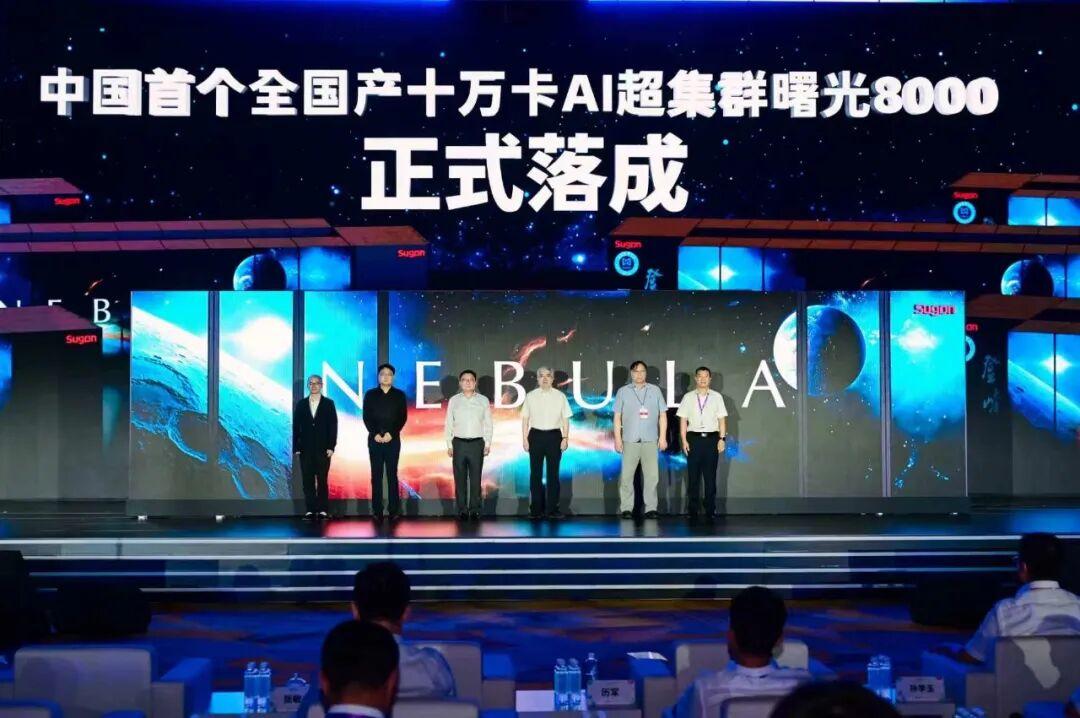
In terms of project progress, system development began in 2024, engineering construction was completed in 2025, a trial run with 30,000 cards was launched in February this year, a 60,000-card AI4S cluster was deployed in April, and the 100,000-card deployment was realized by July. According to Li Bin, Senior Vice President of Sugon, the Sugon 8000 possesses full-chain domestic self-developed capabilities in chips, computing, storage, networking, cooling, management, and services. Its underlying layer uses domestic chips such as Haiguang, connected via scaleFabric-like IB native RDMA high-speed networks for reliable connectivity, supported by ParaStor distributed storage. This storage system achieved first place in both the production-type full-node and 10-node performance categories of the 2026 Global IO500 rankings. Additionally, Sugon's liquid cooling technology is used to support MW-level high-power-density deployments, improving energy efficiency through domestic coolants and year-round natural cooling.
Sugon has connected the Sugon 8000 to the National Supercomputing Internet, making it available to research institutions and industries as a computing service. To date, the cluster has completed over 300 application adaptations, covering more than 20 fields including materials, electromagnetics, quantum, biomedicine, astronomy, and meteorology, and has conducted over 70 computing tests at the 10,000-card scale. In real-world scenarios, the cluster has used 80,000 cards to accelerate the full simulation of protein folding for new drug development; 88,000 cards to complete a direct simulation of 328 trillion grid points of turbulence, supporting aviation and shipbuilding; and 90,000 cards to collaboratively perform DFT high-precision simulations of 3.16 trillion atoms.
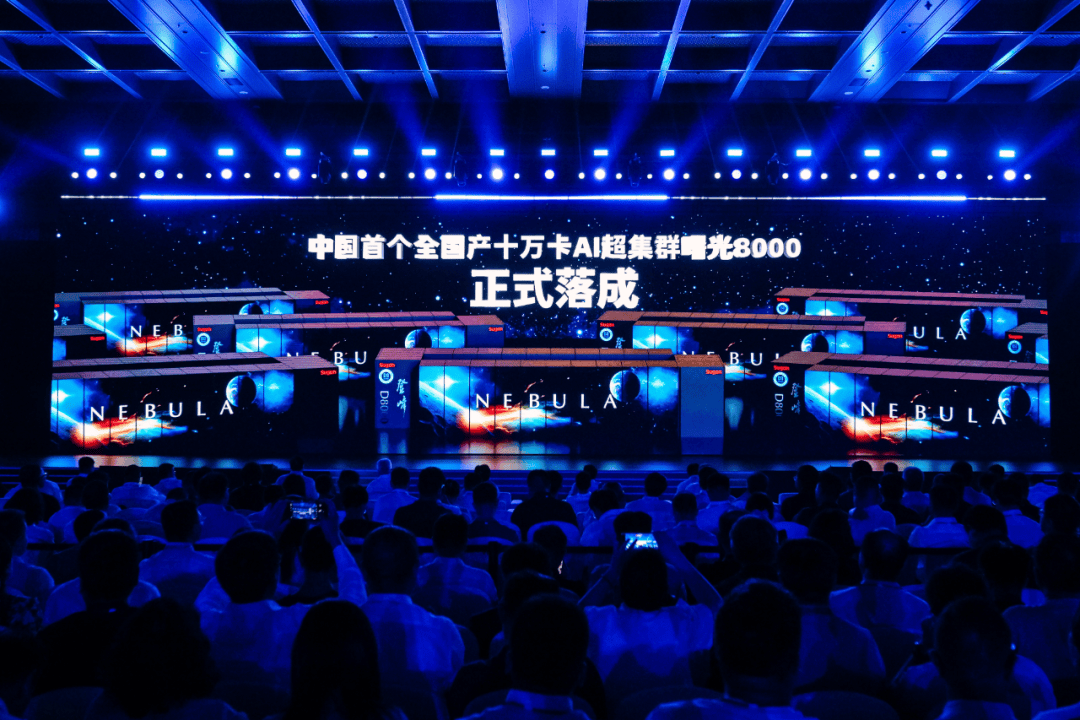
The Sugon 8000 adopts an open AI computing architecture, supporting multiple brands of AI accelerator cards and compatibility with mainstream ecosystems. During the conference, Sugon and the Beijing Academy of Scientific Intelligence reached a strategic cooperation, officially launching the development and construction of a second domestic 100,000-card super-intelligent fusion computing system. This project, located in Zhengzhou, leverages its geographical, energy, and network node advantages, aiming to add a 100,000-card-level backbone node to the national integrated computing network.