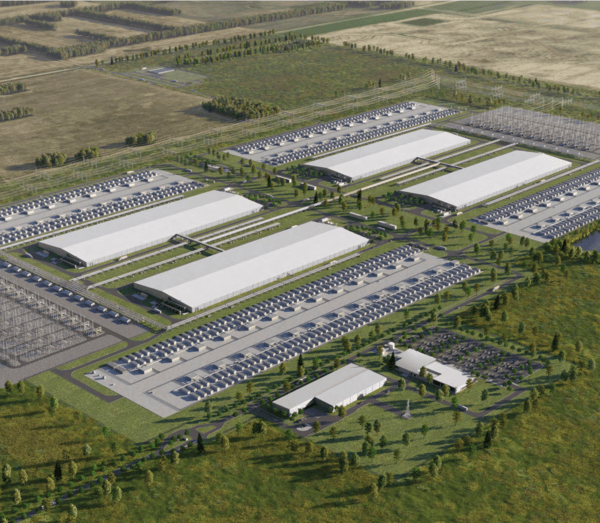
en.Wedoany.com Reported - Recently, US logistics real estate and data center infrastructure developer Prologis submitted a construction plan to build a 99-megawatt data center in southern San Jose, California. Located at 5977 Silver Creek Valley Road, the project occupies approximately 15 acres and proposes a three-story data center building with a total gross floor area of about 516,000 square feet, equivalent to approximately 47,900 square meters. The construction period is estimated to be about two years. The project is currently in the planning and submission stage and has not yet completed environmental review and final construction approval.
Approximately 30,000 square feet of the planned building will be used for office and support spaces, while the remaining area will primarily house server rooms, power equipment, cooling facilities, network equipment, and operation and maintenance systems. The three-story structure can increase the concentration of server rooms and infrastructure within a limited land area, but it also requires specialized design for floor load-bearing capacity, vertical power supply, cooling pipelines, equipment hoisting, and fire protection zones. At this stage, it has not been disclosed whether the project will adopt traditional racks, liquid-cooled servers, or a combination of both, nor has the final number of racks or power density per rack been revealed.
The data center plans for a maximum power capacity of 99 megawatts and will include the construction of an independent substation within the project site. US Prologis also plans to build new transmission lines and related grid connection facilities, and will bear the costs of transmission upgrades required for the project, ensuring that the new load does not rely entirely on existing regional distribution lines. The project site is located less than 3 miles from existing Pacific Gas and Electric Company substation facilities, providing conditions for subsequent high-voltage power access and transmission line construction.
With a 99-megawatt power configuration, the data center's power supply system needs to cover multiple levels, including external grid access, on-site substation, step-down distribution, uninterruptible power supply, and end-of-row power distribution. Server equipment cannot directly use the high-voltage power provided by transmission lines; after electricity enters the campus, it must undergo voltage transformation, switching, and distribution before being delivered to the racks. To prevent a single point of failure from causing a complete facility shutdown, the plan also includes a second independent transmission line route, providing the project with two power connections from different directions or paths.
The project will include a backup power generation area to provide emergency power for critical equipment during external grid failures or internal power system maintenance. The backup power supply needs to operate in coordination with the uninterruptible power supply system: after an external power outage, the battery system will first handle the short-term load, followed by the startup of generation equipment to take over continuous power supply. The planning documents have not yet disclosed the number of backup generators, unit capacity, fuel type, or continuous operation time, so the final scale of the backup power supply cannot be determined at this time.
In addition to power infrastructure, the project also requires the construction of server heat dissipation and server room temperature control systems. Publicly available plans indicate that the data center's expected water usage is equivalent to that of approximately 40 households, but it has not yet specified whether air cooling, closed-loop water cooling, or hybrid cooling technology will be used. The cooling solution will directly impact the project's water consumption, auxiliary power usage, equipment layout, and operational noise levels. Relevant parameters are expected to be further determined during subsequent environmental reviews and architectural design phases.
This land was previously planned for the construction of an approximately 281,900-square-foot industrial warehouse, for which a permit had been obtained, but the project did not proceed to actual construction. After US Prologis adjusted the land use to a data center, the building area increased to approximately 516,000 square feet, and the power infrastructure was transformed from the distribution system of a typical industrial building to a 99-megawatt data center power supply system. Loading docks, trailer parking areas, and logistics facilities from the original warehouse plan will no longer be the focus of construction; the new project design will revolve around server rooms, substations, backup power, and network communication facilities.
The project's exterior facade will initially feature a gray-white block structure, with facade segmentation, landscaping, and architectural details to reduce the visual impact of the large three-story building on the surrounding environment. The daily vehicle and personnel traffic after the data center becomes operational is typically lower than that of a similarly sized logistics warehouse, but during construction, it will involve concentrated transportation of earthwork, concrete, steel structures, electromechanical equipment, transformers, generation equipment, and server infrastructure. US Prologis estimates that the main construction and infrastructure work will take approximately two years, with the actual start date depending on planning permits, grid interconnection studies, and transmission engineering arrangements.
US Prologis is also advancing another larger-scale data center campus in San Jose. Located on Zanker Road, near the Los Esteros Energy Center, this project plans to build four two-story data center buildings, each with a power capacity of up to approximately 99 megawatts, bringing the total campus capacity to nearly 400 megawatts. The Silver Creek Valley Road project is not the same construction project as this campus; the former is a single 99-megawatt facility, while the latter is a comprehensive campus comprising multiple data center buildings and supporting infrastructure.
Currently, US Prologis has secured or is in negotiations for approximately 5.6 gigawatts of data center power capacity, with plans to expand its data center capacity to up to 10 gigawatts over the next decade. The 99-megawatt San Jose project will first complete planning review, power system impact assessment, and environmental review before determining the construction schedule for transmission facilities, on-site substations, backup power, and the main building. The project's client, server deployment scale, official start date, and commissioning date have not yet been announced.