China's Four Departments Propose Building an Intelligent Agent Interconnection Network Infrastructure with Unified Communication Protocols and Interface Standards
en.Wedoany.com Reported - The Ministry of Industry and Information Technology, the Cyberspace Administration of China, the National Development and Reform Commission, and the National Data Administration jointly issued the "Guiding Opinions on Promoting the High-Quality Development of Internet Basic Resources," proposing to explore the construction of an intelligent agent interconnection network infrastructure with unified communication protocols, data interaction standards, and interface specifications for scenarios such as agent-to-agent, agent-to-external tools, and agent-to-frontend applications. The document also deploys tasks including satellite internet supporting facilities, digital identity service facilities, and the integration of the industrial internet identification resolution system with the domain name system, indicating that the scope of internet basic resource construction will extend from websites, applications, and connected devices to artificial intelligence agents capable of autonomously identifying tasks, invoking tools, and executing collaboratively.
Currently, agents developed by different enterprises, model platforms, and industry systems typically adopt their own identity systems, capability description methods, and invocation interfaces. Even if an agent can perform data queries, device control, or business approvals, it may not be recognized or invoked by another platform; different systems often require developing interfaces one by one, reconfiguring identity permissions, data formats, and security rules. The four departments' proposal to unify communication protocols, data interaction standards, and interface specifications primarily aims to solve the problem of agents being "undiscoverable, incomprehensible, uninvocable, and difficult to collaborate."
From a network engineering structure perspective, agent interconnection cannot rely solely on a general application programming interface; it requires establishing a comprehensive system covering identity identification, capability description, service discovery, task delivery, tool invocation, permission authentication, and operational auditing. When a user submits a complex task to a frontend application, the main agent may need to invoke a data query agent, map service, enterprise database, industrial software, and payment tools, and then reassemble multiple execution results. Unified protocols can specify how tasks are expressed, how capabilities are declared, and how different agents exchange information; data standards address inconsistencies in field formats, semantic definitions, and result return methods; interface specifications determine the connection methods agents use to invoke software tools, hardware devices, and external services. Only when these basic rules can be executed across platforms can multi-agent collaboration transition from customized enterprise projects to larger-scale network deployment.
Relevant standard systems have begun to take shape. The National Standard Information Public Service Platform shows that the "Artificial Intelligence - Intelligent Agent Interconnection" series of national standard guiding technical documents has covered aspects such as overall architecture, identity codes, identity management, agent description, agent discovery, agent interaction, and agent tool invocation. Among these, the overall architecture standard was released and implemented on May 22, 2026. The Cyberspace Administration of China's previously issued "Implementation Opinions on the Standardized Application and Innovative Development of Intelligent Agents" also proposed establishing an agent standard system, promoting agent interconnection protocols, and accelerating the formulation of interface standards between agents and software tools, application services, and hardware peripherals. This latest guiding opinion further extends protocol and standard requirements to the network infrastructure level, shifting agent interconnection from a product functionality issue to an internet basic resource construction issue.
The document also proposes strengthening the planning and construction of supporting facilities for new infrastructure such as satellite internet, accelerating the implementation of typical scenarios, and steadily expanding the scope of application. This arrangement ensures that agent interconnection is no longer confined to fixed data centers and terrestrial broadband networks. In environments where ground networks struggle to provide continuous coverage, such as ocean shipping, remote mining areas, agricultural production, emergency rescue, and traffic operations, agents can obtain data, invoke remote systems, and return execution results via satellite internet. China's relevant plans have already included satellite internet alongside the national integrated computing power network and information communication network as directions for new infrastructure construction, proposing the coordination of satellite internet constellations, launch and telemetry control, security protection, and key industry applications.
Digital identity service facilities will undertake the task of identity confirmation for agents and network resources. Once agents have the ability to autonomously invoke tools and execute operations, the network needs to determine who created them, on whose behalf they perform tasks, what permissions they have, and whether invocation behaviors can be traced. Without an identity system, malicious agents could impersonate legitimate services, access data without authorization, or send false tasks to other systems. Agent interconnection standards have already listed identity codes and identity management as separate foundational elements, indicating that identity authentication will form part of the infrastructure alongside communication protocols, service discovery, and tool invocation, rather than being an additional security module deployed after completion.
The integration of the industrial internet identification resolution system with the domain name system may establish connection entry points for industrial agents to access equipment, products, and production systems. The domain name system primarily addresses the addressing of internet services, while the industrial internet identification resolution system can provide identifiers for machines, components, products, and data objects. After the two systems are coordinated, agents will not only need to find a specific website or application but may also locate an industrial device, a batch of products, or a piece of production data based on identifiers, and initiate queries, diagnostics, and control tasks within authorized permissions. Recent industrial internet policies have proposed expanding national top-level nodes, enhancing the service capabilities of secondary nodes, and strengthening connected device management through "one item, one code, one number," providing identification and network foundations for agents to enter industrial scenarios.
Currently, the guiding opinion uses the phrase "explore the construction," indicating that the agent interconnection network is still in the stages of standard refinement, architecture validation, and typical scenario development, and does not imply the immediate construction of an independent network replacing the existing internet. A more likely implementation path is to rely on IPv6, 5G, optical fiber networks, industrial internet, computing facilities, and satellite internet, adding agent identity, capability discovery, task routing, data exchange, and security management functions on top of existing basic networks. Future engineering milestones worth monitoring include the construction of agent interconnection test networks, deployment of unified interfaces in industry platforms, pilot projects for digital identity facilities, and whether cross-platform invocation can be achieved among industrial agents, public service agents, and enterprise applications. The China Academy of Information and Communications Technology has already initiated research on agent internet infrastructure and is advancing the construction of demonstration networks, interconnection test networks, and public service platforms.
Related Products



GYTA Type Non-Self-Supporting Aerial/Duct Optical Cable
TONGDING INTERCONNECTION INFORMATION CO., LTD.

Multi-function Marine Monitoring Low-altitude Detection Radar Sea-air Boundary Ocean Dynamic Environment Measurement
Chengdu Dixin Technology Co., Ltd.
Conveyor Belt Intelligent Monitoring System
LUO YANG WIRE ROPE INSPECTION TECHNOLOGY CO., LTD.

G.652.D Wavelength-extended Non-dispersion Shifted Single-mode Optical Fiber
HONGAN GROUP CO., LTD.

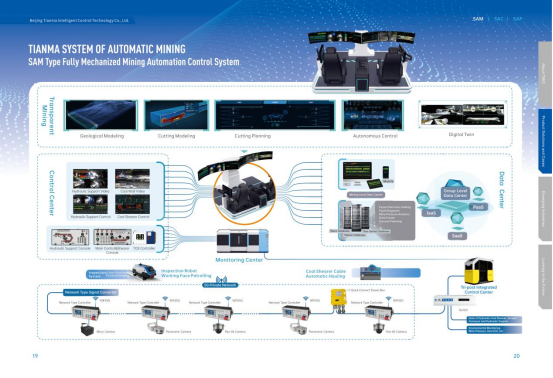
Comprehensive Mining Automation Control System
Beijing Tianma Intelligent Control Technology Co., Ltd.

Hot Selling 10 Inch Intel N5100 I5 I7 FHD 8 +128GB 16+256GB Win10 Pro Win11 Pro 4G 5G Rugged Tablet PC Pad with NFC Barcode
Highton Electronics Co., Ltd.