AVELIN Sovereign AI Platform Expands into UAE and Other Markets, with GPU Infrastructure Scaling Up
en.Wedoany.com Reported - The sovereign artificial intelligence platform AVELIN AI, targeting the UAE and other Gulf regions as well as European and North American markets, is expanding its GPU computing infrastructure and further refining its cross-model fusion technology. The company plans to convert existing commercial collaborations into formal projects, continuing to expand its Gulf region business through the remainder of 2026 while entering regulated industry markets in Europe and North America. Its platform primarily serves institutions in finance, healthcare, government, and critical infrastructure sectors that demand high standards of data security, compliance management, and system control.
AVELIN's development focus is not on providing clients with a single large model, but on building an AI platform that enterprises or governments can control, deploy, and govern independently. In scenarios such as finance, healthcare, and public administration, business data typically cannot be arbitrarily transmitted to external public models, and the model invocation process must also meet requirements for data storage location, access permissions, audit trails, and industry regulations. Therefore, a sovereign AI platform needs to integrate models, computing power, data management, and security mechanisms within a unified technical framework, enabling clients to clearly identify data storage locations, model usage scopes, and system operation permissions.
The company plans to expand its GPU infrastructure to support model training, inference, and multi-model collaborative tasks. For institutions that need to run AI systems internally, building computing power involves not only increasing the number of GPU servers but also data center access, compute node interconnection, storage capacity, model deployment platforms, and operational monitoring systems. Regulated industries typically also require setting up isolated environments to prevent sensitive data from being shared with other users, and mitigating information leakage risks through access control, logging, and data segregation.
Cross-model fusion is a technical direction that the AVELIN platform continues to strengthen. Different models vary in language processing, code generation, data analysis, and domain-specific knowledge, and a single model may not meet all the needs of complex institutions. AVELIN's Cross-Model Fusion technology attempts to incorporate multiple models into a single task processing workflow, selecting or combining outputs from different models based on specific business needs, allowing clients to avoid long-term lock-in with any single model provider.
This architecture also provides enterprises with greater model selection flexibility. When external model versions, service policies, or regulatory requirements change, clients can adjust the models they invoke without rebuilding all AI applications. For government agencies, banks, healthcare institutions, and infrastructure operators, such a replaceable and manageable model system helps reduce dependence on a single platform. However, its practical effectiveness still depends on whether data formats, interfaces, and permission management remain consistent across different models.
AVELIN has received technical support from organizations such as NVIDIA Inception, AWS Activate, and the Dubai Future Foundation, and is also participating in projects related to Red Hat, DigitalOcean, and OVHcloud. These collaborations cover the GPU ecosystem, cloud computing, open-source platforms, and data center resources, providing the computing environment and technical adaptation conditions for its platform expansion. In the next phase, the company needs to further integrate these resources into deliverable sovereign AI systems, including completing model deployment, connecting cloud and local environments, scheduling computing resources, and adapting to industry security requirements.
AVELIN was founded by AI entrepreneur Yury Akinin, who previously participated in building a life sciences AI company and managed engineering teams serving large enterprise clients. The company currently aims to transform sovereign AI from a concept into a deployable platform for enterprises, enabling clients to run models within their own governance frameworks rather than entrusting sensitive operations entirely to external public AI services.
As it advances its business in Europe and North America, AVELIN will face varying data protection, industry access, and AI governance requirements across different regions. The Gulf region focuses more on local computing power, data sovereignty, and national-level AI capability building; the European market imposes high demands on data protection and model compliance; and North American enterprises are more concerned with system performance, platform compatibility, and integration with existing IT environments. Whether the company can adapt its GPU deployment methods, data management rules, and model interfaces to different markets will determine the actual progress of its global expansion plans.
Related Products

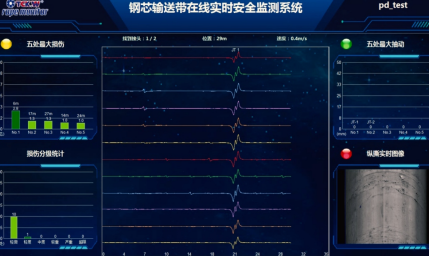
Conveyor Belt Intelligent Monitoring System
LUO YANG WIRE ROPE INSPECTION TECHNOLOGY CO., LTD.



MUX Series Communication Interface Device for Security and Stability Control System
Nanjing NR Electric Co., Ltd.
Multi-function Marine Monitoring Low-altitude Detection Radar Sea-air Boundary Ocean Dynamic Environment Measurement
Chengdu Dixin Technology Co., Ltd.
Automatic Aiming Laser Remote Obstacle Removal Robot
Pinggao Group Weihai High-Voltage Apparatus Co., Ltd.