GKN Aerospace and University of Nottingham Launch Startup to Develop Cryogenic Motors
en.Wedoany.com Reported - GKN Aerospace and the University of Nottingham have jointly established a startup named HPDrive Technologies, aimed at developing cryogenically cooled motors for hydrogen-electric aircraft.
The technology foundation of this venture comes from the cryogenic motor technology developed by GKN Aerospace through the UK government-funded H2GEAR project. The H2GEAR project, costing £40 million (approximately $54 million), was the largest single R&D project funded by the UK's Aerospace Technology Institute, running from 2020 to 2024. Its follow-up projects, HyFIVE and H2FlyGHT, were shelved and downgraded after GKN withdrew following Airbus's reduction of its hydrogen ZEROe program.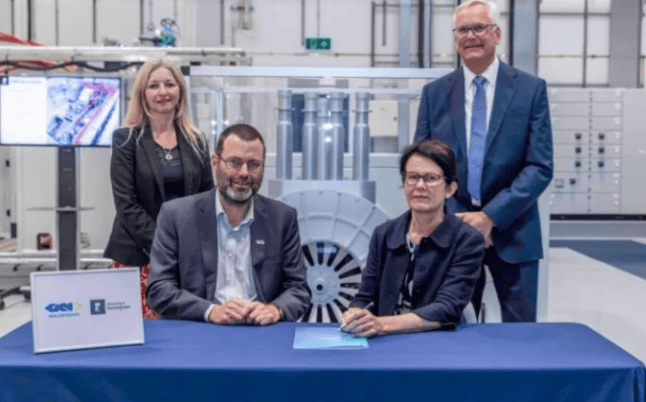
GKN previously developed a 1-megawatt-class cryogenically cooled motor at its Global Technology Centre in Filton, UK. HPDrive will further develop this motor with the goal of commercializing the technology.
Russ Dunn, Chief Technology Officer of GKN, stated at a press conference in London in April that the University of Nottingham is the strongest motor research institution in the UK, and it was decided to take over motor development responsibilities in the H2FlyGHT project. He added that HPDrive will inherit and acquire all of GKN's cryogenic motor intellectual property and will open up to other investors to drive further technological development, providing a new outlet for GKN's excellent innovation work.
Cryogenically cooled motors (also known as cryo-motors) are a key technology for future large hydrogen-electric aircraft. Standard motors become too heavy for flight when power requirements reach approximately 1 megawatt or more.
Max Brown, Vice President of Technology at GKN Aerospace, stated that the establishment of this company creates a dedicated pathway for the technology, expertise, and capabilities developed under the H2GEAR project, aiming to bring advanced cryogenic motors to future industrial and aerospace applications. Through the joint venture with the University of Nottingham, GKN supports the continued development of a strategically important capability for the UK and helps advance the technologies needed for the long-term transition to zero-emission flight.
Henner Wapenhans, CEO of HPDrive, stated that through this new venture, the team will further develop advanced cryogenic motor technology and accelerate its deployment in future industrial and aerospace applications. The University of Nottingham said in a press release that HPDrive is currently advancing its technology development roadmap and engaging with potential partners.
Related Products



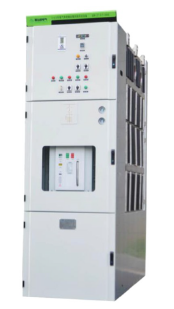
GSR6-27.5kV SF6 Free Gas-insulated Metal-enclosed Switchgear
Zhejiang Juhonkia Intelligent Electric Co., Ltd.

Pantograph-Catenary Comprehensive Detection Device (1C)
CHENGDU TANGYUAN ELECTRIC CO., LTD.
Industrial and Commercial Point-Type Gas Detector
Jinan Benan Technology Development Co., Ltd.
Explosion-proof lithium battery dispatching monorail crane locomotive (permanent magnet frequency conversion integrated machine)
Xiangtan Hengxin Industrial Co., Ltd.