Osaka Metropolitan University Develops Programmable Thermal Control Device Achieving 0.9 Nonreciprocity Factor at 3-Degree Incident Angle
en.Wedoany.com Reported - Researchers at Osaka Metropolitan University have developed a programmable thermal control device that can not only control the location of heat radiation but also retain its configuration state after power loss. This achievement is expected to provide smarter thermal management solutions for high-performance chips, silicon photonics, infrared sensors, and energy harvesting systems. The research, published in Laser & Photonics Reviews, addresses two major challenges that have long hindered the practical application of nonreciprocal thermal control devices.
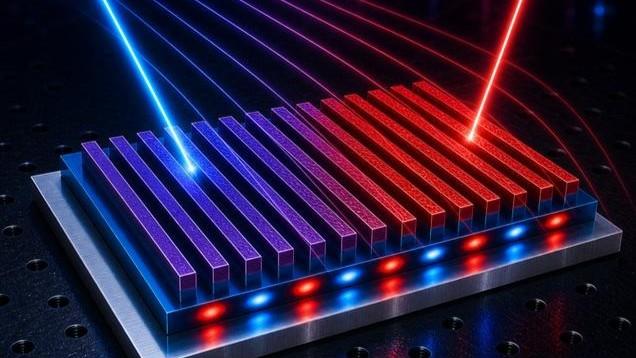
The device combines a magneto-optical material—a material whose optical properties change under a magnetic field—with the phase-change material germanium antimony telluride (GST), enabling independent control of how a surface absorbs and emits infrared radiation. Unlike previous designs, this device operates under nearly normal incidence and maintains its programmed state without continuous power supply. Traditional materials obey Kirchhoff's law of thermal radiation, which states that a surface has equal absorption and emission efficiency at a given wavelength and direction, limiting engineers' ability to precisely manipulate heat. Devices capable of independently controlling absorption and emission could improve optoelectronic technologies such as radiative cooling, thermophotovoltaic systems, infrared sensing, and thermal communication.
Researchers have explored various methods to achieve this by breaking Lorentz reciprocity, with most approaches relying on magneto-optical materials, magnetic Weyl semimetals, or actively modulated metasurfaces. However, these designs typically face two major bottlenecks: either they require light to strike the surface at extremely oblique angles to produce strong directional behavior, or they are volatile—their behavior disappears once the magnetic field, electrical signal, or heat source controlling them is removed. The Osaka Metropolitan University team overcame these limitations by combining two materials with complementary functions. The first is indium arsenide (InAs), a magneto-optical semiconductor whose interaction with infrared light changes under a magnetic field, introducing directional asymmetry. The second is GST, a phase-change material that can reversibly switch between amorphous and crystalline states, causing dramatic changes in its optical properties, and it retains whichever state is written, even after power is removed.
The researchers patterned GST into microscopic gratings above the InAs layer, forming what is called a magneto-optical metagrating. InAs provides directional control, while the GST layer acts as a nonvolatile switch. Applying a magnetic field adjusts how infrared radiation interacts with the structure, while changing the GST phase permanently alters that behavior. The prototype achieved a nonreciprocity factor close to 0.9 at a working incident angle of only 3 degrees, far smaller than the steep angles typically required by previous designs. The system also supports continuous tuning by varying the magnetic field or incident angle, as well as digital switching through GST phase transitions. The research team analyzed why the nonreciprocal effect weakens when the GST state changes, attributing it to a combination of optical field redistribution and increased damping, rather than solely to absorption losses.
This technology remains at an early research demonstration stage. As processors integrate more transistors, chiplets, and photonic components into compact packages, the ability to program thermal radiation could prove valuable in computing hardware—for example, channeling heat away from hot spots, reducing thermal interference between adjacent chiplets, or stabilizing silicon photonic devices whose optical properties drift with temperature changes. The researchers also foresee applications in radiative cooling, thermophotovoltaic energy conversion, infrared emitters, thermal communication systems, and photonic memory technologies. For now, this work remains a laboratory demonstration, and significant engineering challenges must be overcome before commercial deployment is realized.
Related Products

Overseas IEC Gateway Energy Meter - DTSD341/DSSD331-aMeter390
Wasion Group Limited Co., Ltd.

Pneumatic high-pressure wear-resistant ball valve
Zhejiang Deca Control Valve Meter Co., Ltd.
Ultrasonic Wind Speed and Direction Instrument
Kingmach Measurement & Monitoring Technology Co., Ltd.
LVB Series 35-500kV Oil-immersed Inverted Current Transformer
Shandong TaiKai Instrument Transformer Co., Ltd.
40.5kV-1100kV Gas Insulated Metal-Enclosed Switchgear (GIS)
Henan Pinggao Electric Co., Ltd.
Quick-Change Single-Seat Control Valve / Quick-Change High-Pressure Single-Seat Control Valve
Beijing Consen Automation Technology Co., Ltd.

Off-Grid Fuel Cell Supercharging Station (180kW Configuration)
Shanghai REFIRE Group Limited