Chicago Transit Authority Launches $492 Million Blue Line Improvement Plan
en.Wedoany.com Reported - The Chicago Transit Authority (CTA) has launched a $492 million Blue Line improvement plan, focusing on track bed rehabilitation in the downtown segment to eliminate speed restrictions and enhance line safety and reliability. The project covers approximately 3 miles between the LaSalle and Illinois Medical District stations, an area operating 24/7 with over 80,000 daily riders, where any service disruption has significant impact.
Built in the late 1950s, the CTA Blue Line has seen most of its infrastructure reach the end of its service life despite regular maintenance and upgrades. Before the project launch, nearly 70% of the line was under speed restrictions. This improvement project will eliminate approximately 15,000 feet of speed-restricted zones through track bed rehabilitation and other works. The contract package includes the first phase of track bed reconstruction on the Forest Park branch.
The underlying subgrade soil in this section is soft, with an initial bearing capacity of less than 4%, making it susceptible to erosion and posing a high risk of mud pumping, which leads to ballast contamination. The traditional solution involves excavating 12 inches of subgrade, replacing it with quality material, and then laying new sub-ballast and ballast. To minimize impact on passengers, a tight construction schedule was planned, requiring the team to accelerate construction methods.
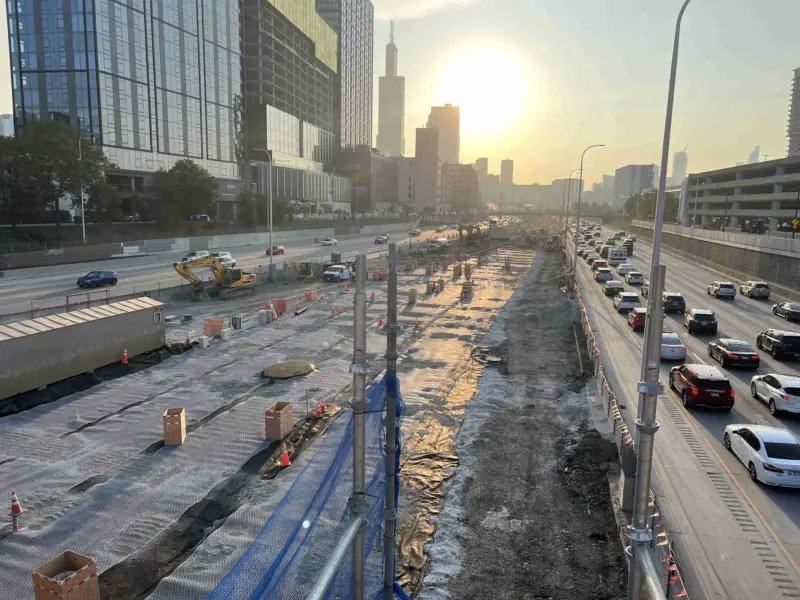
The project team contacted GEOfabrics for a value engineering solution. The proposed solution was to use TrackTex heavy-duty geocomposite to prevent mud pumping and provide construction layer separation. This material consists of a microporous membrane sandwiched between protective nonwoven geotextiles, preventing rainwater from infiltrating the subgrade while blocking the movement of fine particles in clay and silt. Under dynamic loading, the membrane allows pore water to escape, gradually drying the mud beneath the TrackTex and thereby increasing subgrade strength.
This solution allows the poor-quality subgrade material to remain in place without excavation and replacement. However, the low bearing strength of the foundation still required sufficient ballast thickness. To address this, a second geosynthetic layer—Tensar InterAx NXR2 geogrid—was added above the TrackTex to provide additional stabilization of the ballast layer. This approach reduced construction depth to 8 inches of sub-ballast and 12 inches of ballast above the geosynthetic layers.
The solution is estimated to have saved 1,200 truck trips for waste removal and material delivery, resulting in cost savings of over $500,000. Within the urban project area, reduced construction traffic flow and carbon dioxide emissions were additional major benefits. The reduction in material handling meant significantly shorter installation time, with the reconstruction of this nearly 3-mile section completed in just 11 weeks, on time and within budget.
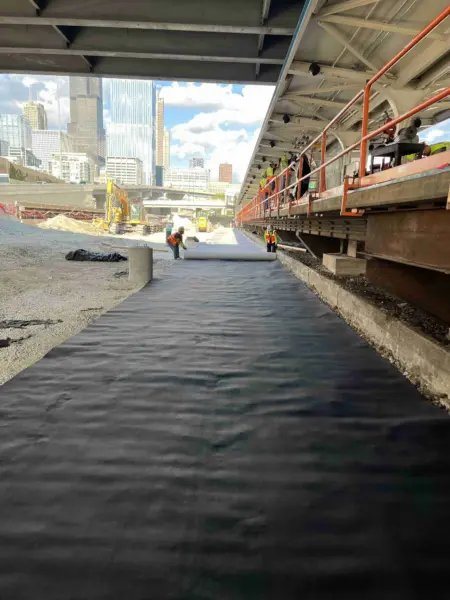
Incorporating TrackTex anti-pumping composite into the ballast layer will prevent ballast contamination by fine particles over time, meaning ballast maintenance intervals can be extended by up to 25 times.

![IVECO Cash-in-Transit [DMT5048XYCL3-AM] - Chongqing Dima Industry Co., Ltd](https://img.wedoany.com/2026/0911/20260911030157582.png)