Chinese Academy of Agricultural Sciences Study Proposes Integrated Policies to Boost Soybean Self-Sufficiency Rate
en.Wedoany.com Reported - Researchers Sun Jing and Wu Wenbin from the Institute of Agricultural Resources and Regional Planning, Chinese Academy of Agricultural Sciences, in collaboration with China Agricultural University and other institutions, published a research paper in Nature Food, systematically exploring pathways to enhance China's soybean self-sufficiency rate and alleviate global land-use pressure through integrated policies.
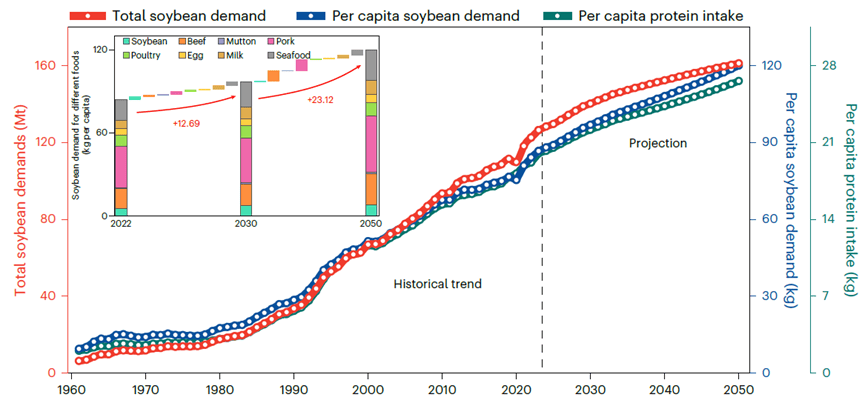
Soybean is a crucial strategic commodity for ensuring China's food security and stable supply of livestock products. The research team reviewed the evolution of China's soybean consumption from 1961 to 2022 and constructed a soybean demand forecasting model for 2030 and 2050. The study indicates that without new policy interventions, China's soybean self-sufficiency rate will continue to decline in the future. However, when synergistically promoting three policies—comprehensive utilization of saline-alkali land, application of agricultural biotechnology, and transition to healthy diets—the self-sufficiency rate can be significantly improved, reducing dependence on the international market.
The study quantified the positive spillover effects of China's increased soybean self-sufficiency on the global scale. As import demand declines, pressure on global soybean resource allocation is alleviated, meeting the consumption growth of a billion-scale population while reducing the need for new cropland expansion in major producing regions such as South America, lowering deforestation risks, and contributing to ecological restoration and carbon sequestration. This yields multiple global co-benefits in food security, climate change response, and biodiversity conservation.
This research provides a new scientific perspective for understanding the transformation pathways of the soybean industry and offers decision-making references for China to balance food security with global sustainable development goals. The findings hold scientific significance and practical value for advancing the comprehensive utilization of saline-alkali land, strengthening agricultural technology support, and serving the carbon peak and carbon neutrality strategy as well as ecological civilization construction.
This study is another achievement by researcher Sun Jing, following her 2018 paper on the environmental effects of international soybean trade published in PNAS, focusing on the main themes of global soybean trade, domestic environment, and food security. The previous work revealed the hidden costs of large-scale soybean imports leading to nitrogen pollution in China, while this study addresses from a policy perspective how comprehensive domestic measures can break import dependence and release global ecological dividends, forming a complete closed loop from problem diagnosis to systematic solutions.
The paper, titled "Integrated policies could raise China's soybean self-sufficiency and ease global land-use pressure," was published in Nature Food in 2026, with authors including Lun F., Sun Jing*, Zhou Y., Hu Q., Gan L., Zhang T., Wang S., Peñuelas J., Sardans J., Lu M., Yang P., Sun D., Liu J., Wu Wenbin*.
Related Products


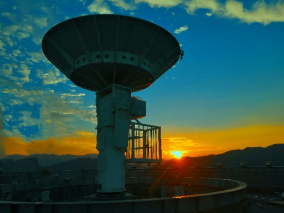
714CD Series C-Band Weather Radar
Chengdu Zhongdian Jinjiang Information Industry Co., Ltd.

Industrial and Commercial Point-Type Gas Detector
Jinan Benan Technology Development Co., Ltd.
4HS-8 High-efficiency Peanut Inverted-laying Harvester
Hebei Yongfa Hongtian Agricultural Machinery Manufacturing Co., Ltd.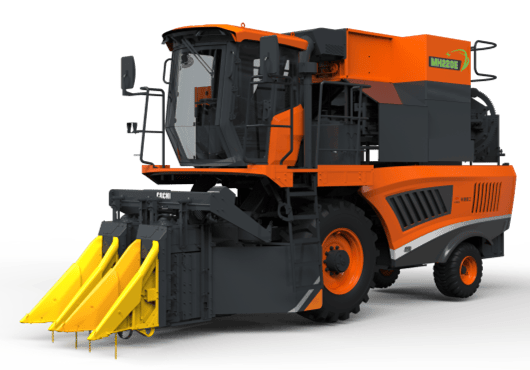
MH220E Two-Row Hybrid Packaged Cotton Picker
CHINA RAILWAY CONSTRUCTION HEAVY NDUSTRY XINJIANG CO., LTD.