Portuguese Study: Biochar Reduces Earthworm Avoidance of Copper-Glyphosate Mixed Contamination by 29%
en.Wedoany.com Reported - A new study led by the University of Trás-os-Montes and Alto Douro in Portugal shows that the combined exposure of copper and commercial glyphosate formulations in agricultural soil induces a significantly stronger stress response in earthworms than exposure to either substance alone. Adding biochar to the soil partially mitigates this behavioral effect, offering a potential practical strategy for managing mixed agricultural pollution.
Copper is widely used as a fungicide in vineyards, orchards, and horticultural systems, and repeated applications can lead to its accumulation in soil to toxic concentrations. Glyphosate-based herbicides are also applied extensively. As both may be used on the same plots during overlapping periods, soil organisms may face simultaneous exposure. Current environmental risk assessments typically examine pollutants individually, potentially underestimating the ecological risks of mixed contaminants. Senior author Rupesh Kumar Singh stated that when copper and glyphosate are assessed separately, the risk posed by the pollutant mixture may be underestimated. Although biochar did not completely eliminate the effects, it significantly improved soil habitability and reduced earthworm responses to contamination.
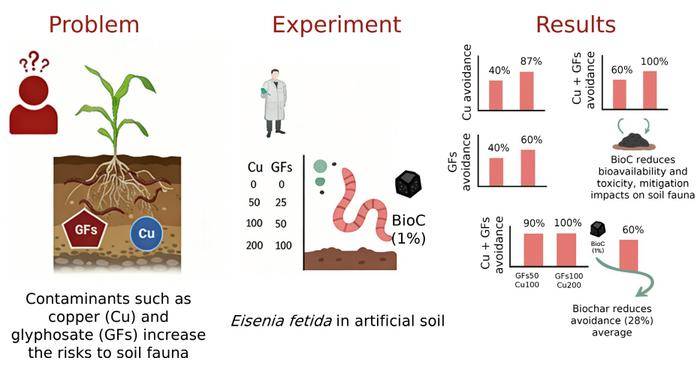
The researchers used the earthworm species Eisenia fetida as a soil health indicator organism in standardized 48-hour avoidance tests. Earthworms could move between uncontaminated soil and soil containing different concentrations of copper, glyphosate formulations, or their mixtures. When tested alone, glyphosate treatments resulted in avoidance rates of approximately 40% to 60%, while copper treatments produced avoidance rates of 40% to 87%. Under combined exposure, earthworm avoidance rates increased from 60% at the lowest mixture concentration to 100% at the highest concentration, indicating that the contaminated soil had become severely unsuitable as a habitat. The authors suggest that interactions between copper and glyphosate may alter their mobility, persistence, or bioavailability, and additives in commercial herbicide formulations may also increase toxicity.
To test mitigation strategies, the team added 1% biochar by soil weight (equivalent to an agronomic application rate of approximately 20 metric tons per hectare), produced from the pyrolysis of forestry residues. In the combined treatments, biochar reduced earthworm avoidance rates by 29%, and by 27% in the highest contamination treatment. Its porous structure and reactive surface groups can immobilize copper and glyphosate, reducing the bioavailable fraction in the soil. The study emphasizes that the experiments used standardized artificial soil to control conditions, while natural soils are more complex, thus requiring field studies and longer exposure times for validation. The results indicate that earthworm avoidance tests can rapidly detect risks from pollutant mixtures, and biochar may help protect the biological quality of contaminated agricultural soils.
Journal reference: Sousa JR, Matos C, Azevedo T, Gonçalves EN, Rajput VD, et al. 2026. Mitigating the effects of copper and commercial glyphosate formulations using biochar: Insights from Eisenia fetida avoidance tests. Biochar X 2: e015 doi: 10.48130/bchax-0026-0013
Related Products



MH220E Two-Row Hybrid Packaged Cotton Picker
CHINA RAILWAY CONSTRUCTION HEAVY NDUSTRY XINJIANG CO., LTD.
714CD Series C-Band Weather Radar
Chengdu Zhongdian Jinjiang Information Industry Co., Ltd.

Industrial and Commercial Point-Type Gas Detector
Jinan Benan Technology Development Co., Ltd.