en.Wedoany.com Reported - Economic data for the first half of 2026 in Shanghai, China, shows that the output value of the artificial intelligence manufacturing industry grew by 21.8% year-on-year, becoming a key engine driving economic growth. This data was released as the World Artificial Intelligence Conference (WAIC) concluded.
According to the semi-annual economic report, the manufacturing output value of Shanghai's three leading industries (integrated circuits, artificial intelligence, and biomedicine) increased by 14.5% year-on-year. Among them, the output value of the integrated circuit manufacturing industry grew by 19.5%, and the biomedical manufacturing industry grew by 7.2%. At the closing ceremony of the conference, official transaction results were disclosed: as of July 20, the conference organized 177 important global procurement groups, with an estimated intended procurement amount of approximately 20.36 billion yuan, a year-on-year increase of 25%. A batch of key AI projects in Shanghai were signed, covering areas such as AI infrastructure, embodied intelligence, scientific intelligence, and intelligent agent applications, totaling 32 projects with an investment amount exceeding 40.9 billion yuan.
Currently, the global AI industry faces challenges in monetizing large models and computing power costs. Shanghai is transforming algorithms into industrial production capacity by building a complete ecosystem. In 2025, the industrial scale of 394 AI enterprises above designated size in Shanghai exceeded 637 billion yuan, a year-on-year increase of 39.5%.
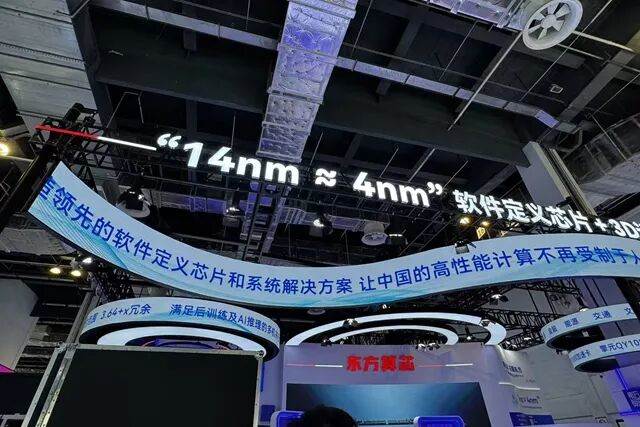
In terms of computing power infrastructure, the conference showcased products including the Huawei Ascend 950 supernode, domestic high-density AI inference cards, and interconnect modules based on silicon photonics technology. The Dongfang Suanxin DF1000 chip, relying on a fully domestic supply chain, adopts a software-defined near-memory computing architecture, achieving a computing output of 520 TFLOPS@BF16 under mature process conditions. Wei Shaojun, Chairman and CEO of Dongfang Suanxin, pointed out that AI chip development faces limitations from both the dedicated route (ASIC), which lacks flexibility and versatility, and the general-purpose route, which is highly dependent on advanced processes. Guo Wei, Vice President of Dongfang Suanxin, added that the DF1000 achieves software-hardware decoupling and dynamic reconfiguration through software-defined chip technology, significantly improving hardware resource utilization via spatial parallelism and time-division multiplexing. Zhou Zhifeng, Managing Partner of Qiming Venture Partners, stated at a sub-forum that the focus of AI computing power demand is shifting towards inference. Over the next two years, infrastructure will face structural shortages, making computing power asset reserves a core corporate strategy. Zhou Zhifeng also noted that AI infrastructure will enter a phase of system-level competition, covering chips, interconnects, cooling, and power supply, potentially giving rise to computing power chips based on new architectures and supernode large clusters to achieve low-cost, high-efficiency token production. At the closing ceremony, the "UniAI·Smart Connect Shanghai" project was launched, with China Unicom planning to invest over 25 billion yuan in Shanghai to strengthen intelligent computing infrastructure construction.
Embodied intelligence is accelerating its transformation from a display item to an industrial product. Data from the Ministry of Industry and Information Technology shows that in the first half of 2025, China's four-legged robots accounted for nearly 70% of global sales share, with over 400 humanoid robot complete machine products. The application penetration rate of artificial intelligence in industrial enterprises above designated size in China has exceeded 30%. Gan Xiaobin, Deputy Director of the Science and Technology Department of the Ministry of Industry and Information Technology, stated that manufacturing is the main battlefield for AI application empowerment, and the ministry is collaborating with various parties to implement special actions such as "Model-Data Resonance" and "Humanoid Robots and Embodied Intelligence Real-World Training." The National and Local Co-built Humanoid Robot Innovation Center, in collaboration with Huawei, released the country's first embodied intelligence training field model point to address bottlenecks such as the lack of high-quality data and insufficient model generalization capabilities. Jiang Lei, Chief Scientist of the National and Local Co-built Center, stated that the model point has achieved breakthroughs in large-scale real-world dataset construction, native VLA (Vision-Language-Action) model development on Ascend computing power, cloud-edge-device collaborative integrated architecture, and one-stop development toolchain. The "Linglong" series robots, equipped with joint innovation results, have entered SAIC Yanfeng, completing real-world data collection and autonomous operation verification. Han Chen, Senior Vice President of ABB Group and President of ABB Robotics China, stated that embodied intelligent robots are entering scenarios such as automotive production lines and logistics. ABB's Shanghai Super Factory, which began production in December 2022, adopts the concept of "robots making robots." Through physical AI deep learning, the success rate of robot operations in some processes has increased from approximately 70%-80% to 99%. The company has partnered with several enterprises focused on embodied large models and plans to explore introducing robots from other companies into its own factories.