US Hop Aero Unveils Cargo Rocket with 250 kg Payload and 750 km Range
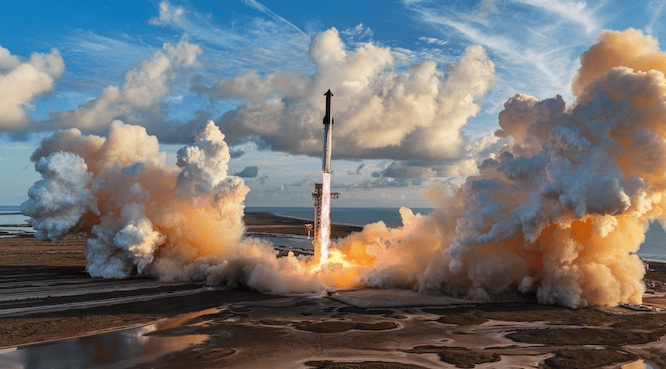
en.Wedoany.com Reported - Hop Aero, a startup from California's Y Combinator, has for the first time revealed technical details of its autonomous cargo rocket, the Rook. The rocket can deliver payloads weighing up to 250 kilograms to a distance of 750 kilometers within 15 minutes, is designed to launch from a standard 40-foot container, and can land on unprepared ground without the need for runways or fixed infrastructure.

The Rook is positioned as a hypersonic cargo delivery solution, applicable to military logistics, particularly for transporting autonomous unmanned system swarms to the battlefield. Hop Aero stated that the reference mission for the 15-minute flight is the route from Okinawa to Taiwan. However, the Rook rocket has not yet undergone test flights; the company has only completed a tethered test of a small-scale prototype at the Oklahoma spaceport. The company's current government funding consists of a $1.25 million Air Force contract, which expires in October.
According to rough calculations, the minimum-energy ballistic trajectory covering 750 kilometers requires a velocity of approximately 2.64 kilometers per second at burnout, with a peak altitude of nearly 181 kilometers, well above the 100-kilometer Kármán line, meaning the rocket will cross the space boundary. The ballistic flight time is approximately 6 to 7 minutes, with the remaining time in the claimed 15-minute total allocated to the boost phase, re-entry into the atmosphere, and landing. The rocket's dimensions are constrained by the internal space of a 40-foot ISO container, which is approximately 12.03 meters long and 2.35 meters wide. For reference, Rocket Lab's Electron rocket stands 18 meters tall and can deliver approximately 300 kilograms of payload to low Earth orbit.
The concept of using rockets for point-to-point cargo delivery has been explored previously. The U.S. Air Force Research Laboratory (AFRL) designated Rocket Cargo as a Vanguard program in June 2021 and awarded SpaceX a $102 million contract in January 2022 to develop the concept using Starship. Starship completed its 13th test flight on July 24, with its upper stage subsequently landing in the Indian Ocean. AFRL renamed the program Point-to-Point Delivery in its fiscal year 2025 budget request, with a funding request of $4 million. An environmental review for the Johnston Atoll landing site, covering up to 10 vehicle landings per year, was suspended in July 2025. AFRL's re-entry demonstration using Rocket Lab's Neutron rocket has also not yet flown.
Hop Aero was founded by Jacob Balaj, who previously worked at Masten Space Systems. Over 18 years, Masten completed more than 600 vertical takeoff and landing flights and had developed the Xogdor vehicle for point-to-point cargo delivery before filing for Chapter 11 bankruptcy in July 2022. In September of that year, Astrobotic acquired Masten's assets for $4.5 million. By comparison, the U.S. Navy addresses similar resupply challenges by 3D printing spare parts at deployment locations. Another Y Combinator company, Inversion Space, has raised $44 million in Series A funding and employs approximately 60 people, but its small demonstrator, Ray, failed to de-orbit in January of last year after an electrical short prevented its deorbit engine from igniting.
No company has yet successfully operated a licensed commercial point-to-point cargo delivery service. Hop Aero's Rook remains in early development and must overcome multiple technical and regulatory challenges before entering operational service.
Related Products

ERW Welded Pipe (Black Pipe and Hot-dip Galvanized Steel Pipe)
Handan Zhengda Steel Pipe Co., Ltd.
XC-6000e Type Aviation Catering Truck (Fuel Type)
Shenzhen CIMC-TianDa Airport Support Ltd.


Industrial and Commercial Point-Type Gas Detector
Jinan Benan Technology Development Co., Ltd.
GSR6-27.5kV SF6 Free Gas-insulated Metal-enclosed Switchgear
Zhejiang Juhonkia Intelligent Electric Co., Ltd.