German and Finnish Universities Predict Solar PV to Supply About 61% of Global Electricity by 2050
en.Wedoany.com Reported - Researchers at Leibniz University Hannover in Germany and LUT University in Finland conducted a systematic review of 60 peer-reviewed energy transition studies. Most studies indicate that by 2050, solar photovoltaics (PV) and wind power will together account for 80% to 99% of electricity generation; model results for the share of PV alone range from 5% to 98%. The divergence in conclusions primarily stems from differences in full-load hours across countries, techno-economic assumptions adopted by the models, and the level of modeling complexity.
The study is titled "Prospects for Solar PV as a Future Dominant Energy Source in Highly Renewable Energy Transition Scenarios." All 60 studies included were peer-reviewed, each covering at least the power, heat, and transport sectors, and setting a target of no less than 95% renewable energy supply by 2050. In addition to synthesizing the findings of each study, the work focuses on analyzing the key assumptions driving the divergent results. In the global effort to limit warming to well below 2°C, the defossilization of energy systems relies heavily on solar PV and wind power; PV has entered the energy system at a pace unmatched by any historical power source, driven by falling costs, near-universal availability, and diverse applications.
Cost assumptions are a major reason for the differing conclusions across models. The reviewed studies set capital expenditure (capex) for large-scale PV in 2050 between €151 (US$174.1) per kilowatt and €720 per kilowatt, with about 18% of studies still assuming values above €500 per kilowatt, while current real-world PV costs are already below €500 per kilowatt. Since PV costs have fallen faster than most scenario expectations, models relying on these outdated data systematically underestimate the future role of PV.
Technical performance is as critical as cost assumptions. About one-third of the studies model only a single generic PV technology, without incorporating applications such as single-axis tracking, bifacial modules, floating PV, agrivoltaics, and rooftop prosumer systems. Temporal resolution also affects results: compared with hourly simulations, using representative time periods can significantly distort assessments of variable resources like solar; 80% of the reviewed studies adopted hourly resolution. Models that combine a diverse portfolio of PV technologies with full sector coupling typically yield the highest and likely most realistic PV shares.
Sector coupling expands the scope of PV applications. Power-to-X pathways can convert cheap solar electricity into hydrogen, synthetic fuels, synthetic chemicals, synthetic materials, synthetic food, clean water, and synthetic forests, replacing hard-to-electrify segments in transport and industry that previously relied on biofuel or fossil fuel imports. Slightly more than half of the reviewed studies include at least one synthetic fuel pathway, and whenever such pathways exist, the value of PV to the energy system increases. Carbon dioxide removal, traditionally dominated by bioenergy, now faces unprecedented opportunities in climate restoration. The study suggests that such an energy system can be viewed as an emerging Power-to-X economy, which in essence is often a Solar-to-X economy.
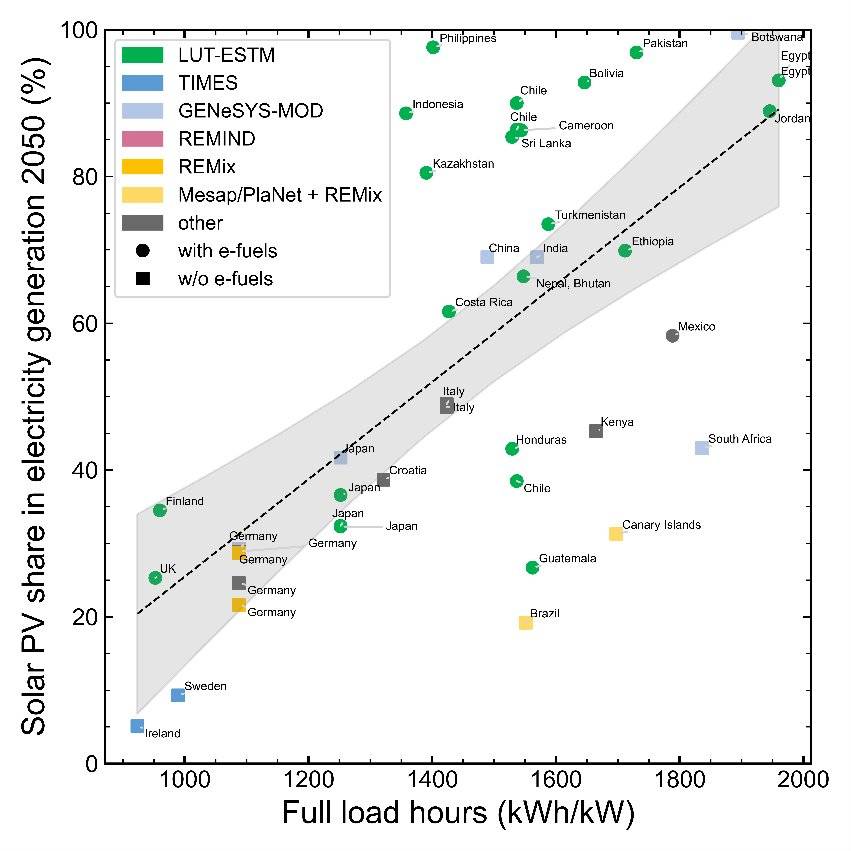
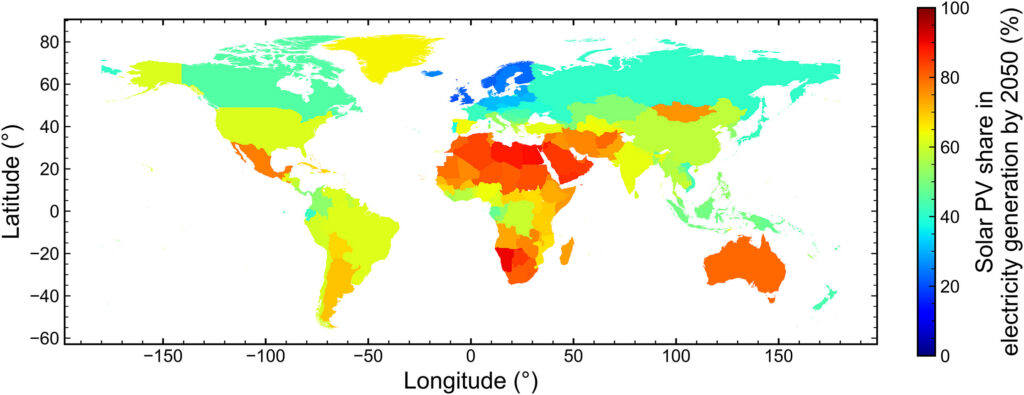
The researchers also derived an empirical relationship between full-load hours and PV share, and applied it globally on a population-weighted basis, estimating that solar PV will supply about 61% of global electricity by 2050. This figure does not come from a single model but is a combined result of dozens of independent teams and different methodologies; individual global models project up to 70% or even higher. The global PV community has already set a target of 75 terawatts of installed capacity by mid-century.
Independent economic forecasts indicate that the global "solar tipping point" may have already been crossed: even without additional climate policies, solar will gradually dominate the electricity market. By 2025, global cumulative PV installations stand at approximately 3 terawatts, with about 700 gigawatts added in that year alone; roughly 70% of new global power capacity added in 2025 came from solar PV.
In models used by the International Energy Agency (IEA) and the Intergovernmental Panel on Climate Change (IPCC), the future role of PV is often underestimated. After correcting outdated cost data and overly simplified modeling approaches, the study concludes that PV will become the dominant energy source in the coming decades. For modelers, there is a need to abandon pessimistic cost curves and incorporate all available PV technologies; for policymakers, planning based on yesterday's assumptions may build yesterday's energy system rather than the one that is coming.
Another study, conducted in collaboration between LUT University, Leibniz University Hannover, the Joint Research Centre of the European Commission, and the Technical University of Denmark, reviewed the evolution of PV's role in such research over the past five decades, based on a database of more than 1,000 analyses of 100% renewable energy systems. In early studies, the PV share was typically negligible, while recent studies give global PV supply shares of 60% to 80%. The study identified 29 milestone articles in the database, each introducing new elements related to PV's role; these milestones fall into four categories: visionary approaches to PV's role, advances in PV system applications, expansion of economic knowledge, and methodological progress enabling more realistic descriptions of PV in energy–industrial systems.
In the most advanced 100% renewable energy system analyses, PV can be described using up to eight system applications, with hourly resolution and interconnected multi-node study designs; models can cover all sectors including power, heat, transport, industry, seawater desalination, and carbon dioxide removal, while incorporating full Power-to-X pathways, flexibility portfolios such as grids, storage, and demand response, as well as diverse sector coupling and energy conversion pathways. However, distinguishing PV systems into ground-mounted, large-scale, and rooftop installations is still far from standard practice, with only 16% of all studies making this distinction. Globally, studies increasingly find that PV accounts for 60% to 80% of total energy supply by mid-century or beyond; the average projection across transition studies is 61%.
The correspondence between these 29 milestone articles and various elements is as follows: 13 are related to visionary approaches, 16 to advances in PV system applications, 15 to expansion of economic knowledge, 13 to methodological progress, and 4 to other specific contributions; a single article can fall into multiple categories. In terms of temporal distribution, the 1970s were dominated by visionary approaches; research activity in this field was limited from the 1980s to the 2000s; the 2010s saw diverse methodological progress laying the foundation for modern 100% renewable energy system analyses; and entering the 2020s, nearly all milestones are expanding methods, economic knowledge, and the diversity of PV systems.
Articles regarded as milestones pushed research perspectives toward very high PV shares through conceptual foundations in the late 1970s and quantitative analyses in the mid-1990s. The introduction of hourly resolution enabled detailed technical feasibility analyses; the value of distributed rooftop PV was recognized early on and ultimately quantified as part of least-cost energy system solutions, despite the lower generation costs of large-scale PV systems. After incorporating diverse Power-to-X pathways and flexibility options into optimization models aimed at minimizing costs, and considering specific technical and social constraints, studies show PV's contribution potential of 60% to 80% for meeting all human energy needs. Nearly five decades of related research have laid the groundwork for comprehensive analyses yielding projections of 61% or higher PV shares, and also help recognize the role of solar PV in building a sustainable civilization—the advent of the solar era.
Related Products


TYC Series High-Efficiency Permanent Magnet Synchronous Motor
Xiangdian Smart Energy Technology Co., Ltd.





Rated Voltage 6-35kV Cross-linked Polyethylene Insulated Power Cable
TONGDING INTERCONNECTION INFORMATION CO., LTD.
IGBT Hydrogen Production Power Supply - High Power Air Cooling
Beijing Zhengzhuo Engineering Technology Co., Ltd.