Wedoany.com Report-Jun 15, Korea Hydro & Nuclear Power (KHNP) has entered into a memorandum of understanding with the Electricity Generating Authority of Thailand (EGAT) to collaborate on small modular reactors (SMRs) and assess their potential for future energy projects in Thailand.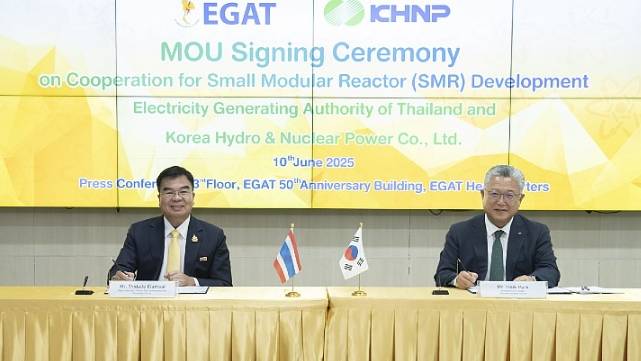
The agreement facilitates the exchange of technical information related to SMRs, a joint evaluation of options for implementing these reactors in Thailand, and cooperation in training through site visits, personnel exchanges, and technology sharing in the nuclear energy sector.
Thidade Eiamsai, EGAT’s Deputy Governor for Power Plant Development and Renewable Energy, stated: “The MOU is an important step towards Thailand’s clean energy future and also plays a part in achieving both EGAT’s and Thailand’s goal of Carbon Neutrality by 2050.” He emphasized that SMRs are well-suited to Thailand’s energy needs, supporting the country’s plan to diversify energy sources and increase clean energy adoption.
Park Insik, head of KHNP’s Export Business Division, said: “This agreement is an important starting point for sharing KHNP’s technological prowess as Thailand’s energy transition partner ... we will continue to work closely with EGAT to create a sustainable energy future for Thailand, while also actively entering the SMR market in the ASEAN region, including Thailand, and establishing a cooperation model that contributes to the global energy transition.”
In March 2025, Thailand and South Korea signed a Cooperation Agreement on the Peaceful Uses of Nuclear Energy, laying the foundation for nuclear energy collaboration. Among the projects under consideration is a partnership with Saltfoss Energy, a Danish company developing molten salt reactor floating power plants, working with South Korea’s Samsung Heavy Industries and KHNP. A feasibility study with Thailand’s Global Power Synergy Public Company Limited is ongoing.
Thailand currently lacks nuclear power in its energy mix but has operated a research reactor since 1977 and has explored nuclear options over the years. South Korea, with 26 nuclear reactors supplying about a third of its electricity, is a leading global nuclear energy provider, increasingly focused on international markets.