OECD projects global GDP growth of 2.9% in 2026
en.Wedoany.com Reported - In its September 2026 interim economic outlook, the Organisation for Economic Co-operation and Development (OECD) projects global GDP growth of 2.9% this year and 3.0% in 2027, but rising energy costs, shifting tariff landscapes and uncertainty over key trade relationships could bring new pressure to international business and supply chains.
The OECD's central projections show global growth facing headwinds from late 2026 into early 2027, followed by a gradual recovery. The organisation warned that commodity price shocks are proving more persistent than assumed. OECD Secretary-General Mathias Cormann said global growth has performed better than expected, but the buffers absorbing the energy shock are being depleted, growth is weaker than last year and inflation is rising again; governments need to direct support where it is most needed, put public spending on a sustainable path and build the foundations for long-term growth, including stronger skills, more diversified energy supplies and faster adoption of artificial intelligence (AI).
Purchasing power is expected to be squeezed as commodity price shocks and higher policy rates weigh, though the OECD assumes that an eventual resolution of Middle East conflicts will help economic activity recover. At the same time, AI investment is becoming an increasingly important pillar of global trade demand; in many Group of Twenty (G20) economies, AI-related spending and production are expected to continue outpacing relatively weak investment in other parts of the business sector.
The projections rest on a series of assumptions about commodity markets. The OECD uses futures pricing as of 14 September, under which Brent crude averages USD 105 per barrel in the fourth quarter of 2026 and European TTF gas averages EUR 82 per megawatt-hour. Prices then decline steadily, with Brent crude averaging USD 85 per barrel and TTF gas EUR 60 per megawatt-hour in 2027. Food commodity prices are assumed to keep climbing into the second quarter of next year, peaking about 11% above their level in the third quarter of 2026. For traders, manufacturers and logistics operators, another assumption is that effective tariff rates remain at mid-September levels for the rest of 2026 and throughout 2027. This effectively embeds the latest round of trade restrictions in the OECD's baseline scenario rather than expecting a broad rollback of tariff barriers.
The policy environment has become markedly more restrictive. The report says continuing tariff changes and the growing use of export restrictions on key products are fuelling "heightened policy uncertainty". New US bilateral tariffs introduced over the summer raised the estimated effective tariff rate on US imports to 10.9% in mid-September from 9.6% in June. After adjusting for the share of goods affected by tariffs, the OECD calculates that Brazil and India saw the largest increases among major economies.
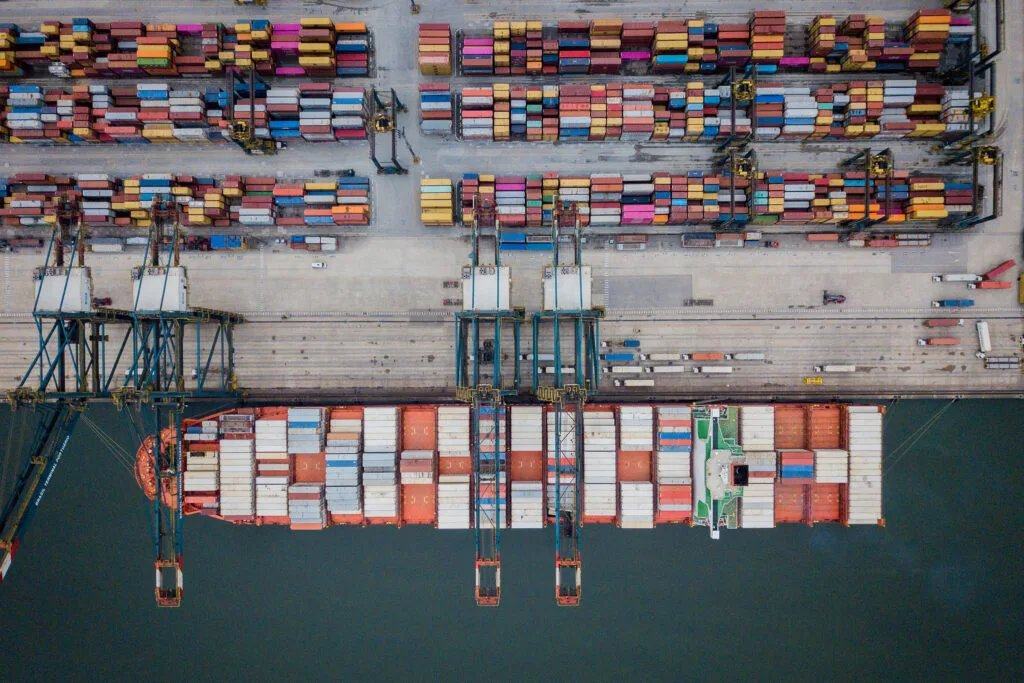
This tariff backdrop coexists with a picture of goods trade flows holding up surprisingly well. The report says that after the initial impact of conflicts, global goods trade gradually recovered despite higher transport costs. AI-related goods have been a major support, especially for Asian economies, while trade in non-AI products also strengthened as commodity prices rose and importing countries rebuilt inventories. Shipping indicators show the goods trade recovery continued into the third quarter, although traffic through the Strait of Hormuz remains at very low levels.
Technology trade features prominently in the OECD's country outlooks. South Korea, a major semiconductor producer, is expected to grow 3.7% in 2026, supported by strong industrial production and export growth, before slowing to 2.6% in 2027. The report notes that technology exports have provided a huge boost to South Korea and Japan, and China has also benefited from the expansion of AI-related trade. North America presents a more complex trade picture. US GDP is expected to grow 2.2% this year and 2.1% next year, supported by AI investment, while weaker purchasing power, slower labour force growth and depleted household savings weigh on consumption. Canada is expected to grow just 0.9% in 2026, rising to 1.3% next year. Although the OECD expects the narrow scope of new US tariffs on Canadian exports to limit their overall economic impact, it points to a potentially broader obstacle: "Uncertainty over the future of the United States Mexico Canada agreement could be a headwind for regional trade growth."
Elsewhere, the euro area is expected to grow just 1.0% in both 2026 and 2027, as energy prices and higher policy rates dampen activity before their effects fade. The United Kingdom is expected to grow 1.1% this year and 1.0% next year. China's growth is expected to slow to 4.5% in 2026 and 4.2% in 2027 from 5.0% in 2025, while India is expected to grow 7.1% in FY2026-27 and 6.5% in FY2027-28.
Inflation remains a core threat to the outlook and to trade costs. G20 headline inflation is expected to rise to 4.1% this year from 3.4% in 2025, before slowing to 3.6% in 2027. In the United States, the OECD specifically highlights the pressure that current tariffs and higher energy product prices are placing on business costs, although headline inflation is expected to fall to 2.6% next year from 3.6% in 2026. The downside scenario illustrates why the outlook for trade-intensive businesses remains unusually fragile. A sustained disruption to Middle East exports could cause shortages of energy and specialised inputs, with net importers in Europe and Asia-Pacific among those most at risk. The OECD warns that disruption would spread internationally through higher consumer prices and shortages of inputs in global supply chains. A combination of sustained energy disruption, higher food prices and tighter financial conditions could reduce global growth by 0.7 percentage points in 2027 while adding 1.1 percentage points to consumer price inflation.
However, the report also points to business adaptability as an important counterweight. It says firms have already navigated a string of adverse developments in recent years, including higher trade barriers, resurgent inflation and worsening labour shortages, and may continue to adjust operations and supply chains in response to disruption. The OECD concludes that making the global trading system fairer and more resilient while preserving the benefits of open markets would help strengthen the prospects for sustainable and resilient growth.
Related Products


0.66kV Power Supply Instrument Transformer
Guangdong Sihui Instrument Transformer Works Co., Ltd.



Standard Nozzle Flowmeter
Jinggong Automatic Control Instrument Complete Technology Development Company
220kV Composite Outdoor Cable Terminal
Shenyang Guolian Cable Accessories Manufacture Co., Ltd.