Uzbekistan Plans Two VVER-1000s and Two SMRs
Wedoany.com Report-Sept. 30, At the World Atomic Week International Forum in Moscow, an agreement was signed to expand Uzbekistan’s proposed nuclear plant to include two VVER-1000 units and two RITM-200N small modular reactors (SMRs). The forum, held over four days, drew more than 20,000 participants from over 100 countries.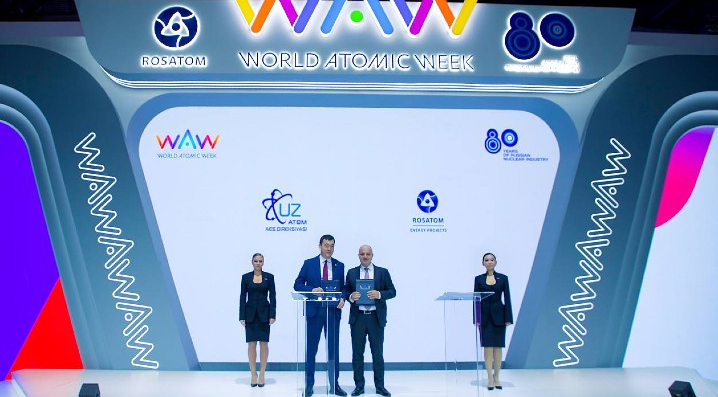
The Uzbekistan agreement was signed by Andrey Rozhdestvin, Director General of Rosatom Energy Projects Company, and Abdujamil Kalmuratov, Head of the Directorate for the Construction of a Nuclear Power Plant State Enterprise. The agreement supplements the earlier Key Terms for Project Implementation, increasing the project’s capacity from the previously planned six SMRs. A separate agreement was also signed covering key terms for future fuel supply contracts.
Azim Akhmedkhadjaev, Director of Uzatom, said: “In the very heart of Uzbekistan, in the Jizzah region, we are creating an unprecedented energy project. By becoming pioneers in the development of Central Asia's nuclear energy, we are not just building the first station in the region - we are the first to create an innovative solution for the future. Our project is a bold combination of advanced small modular reactor technologies and the time-tested solutions of traditional high-capacity nuclear power.”
Alexey Likhachev, Rosatom Director General, added: “The signing marks a new stage in the development of relations between Rosatom and Uzbekistan … Uzbekistan will become the first country in the world to build an integrated nuclear power plant, where both a modern small-scale nuclear power plant and a large-scale nuclear power plant will be operated simultaneously on a single site.” Uzbekistan aims to complete the SMR project design by the end of 2025, with the main implementation phase beginning in 2026.
The forum also hosted the BRICS Nuclear Energy Platform annual conference, aimed at promoting nuclear energy cooperation. Attendees included representatives from Brazil, Vietnam, Egypt, Iran, China, South Africa, the UAE, Ethiopia, Turkey, and the ASEAN Energy Hub. Speakers included Mikhail Chudakov, Deputy Director General of IAEA, Sama Bilbao y León, Director General of World Nuclear Association, Razib Dawood, Executive Director of ASEAN Energy Centre, and Julio Lopes, leader of the Brazilian Parliamentary Front for Technology and Nuclear Activities.
Bilbao y León stated: “A successful nuclear project anywhere is a success for nuclear everywhere. The more we demonstrate we can deliver, the more opportunities we will have for success.” Elsie Pule, Chief Coordinator of the BRICS Nuclear Energy Platform, noted that BRICS and partner countries account for one-third of operating nuclear plants and over 70% of units under construction, expecting to cover two-thirds of global nuclear fleet growth by 2030. The platform approved its first strategic document, addressing human resources, finance, supply chain sustainability, nuclear fuel cycle technologies, and public acceptance.
Other agreements announced included a memorandum of understanding between Rosatom and Vietnam Electricity Corporation subsidiaries for the Ninh Thuan-1 NPP project, covering feasibility studies, infrastructure development, specialist training, and logistics. A session also focused on floating nuclear power plants, with participation from Thailand, Indonesia, Myanmar, the Philippines, Ghana, and South Africa. Andrey Nikipelov, Deputy Director General at Rosatom, highlighted floating units’ scalability and mobility, offering ready-made energy solutions with fully managed generation.
Related Products

Standard Nozzle Flowmeter
Jinggong Automatic Control Instrument Complete Technology Development Company
Overseas IEC Gateway Energy Meter - DTSD341/DSSD331-aMeter390
Wasion Group Limited Co., Ltd.
72.5kV 1250A 31.5kA SF6 free Gas-insulated Metal-enclosed Switchgear
Zhejiang Juhonkia Intelligent Electric Co., Ltd.
Environmentally Friendly Flame-retardant PVC Double-layer Insulated Wire
Sichuan Chndo Cable Co., Ltd.

"Shunyi 1600" Deep-submerging Bottom-sitting Multi-functional Wind Power Engineering Vessel
Zhengli Offshore Engineering Co., Ltd.
Perfluorinated Ionic Membrane-CM-10N Series Membrane
Guizhou Juneng Century Technology Co., Ltd