Wedoany.com Report-Nov. 13, Siemens Mobility conducted the world’s first live demonstration of its Signaling X technology for metro systems at the Singapore Rail Test Centre (SRTC) on Wednesday, marking a major step toward cloud-based train control for urban networks. The event, attended by global transit operators and media, showcased how safety-critical Communications-Based Train Control (CBTC) functions can operate within a centralised, cloud-ready signalling data centre.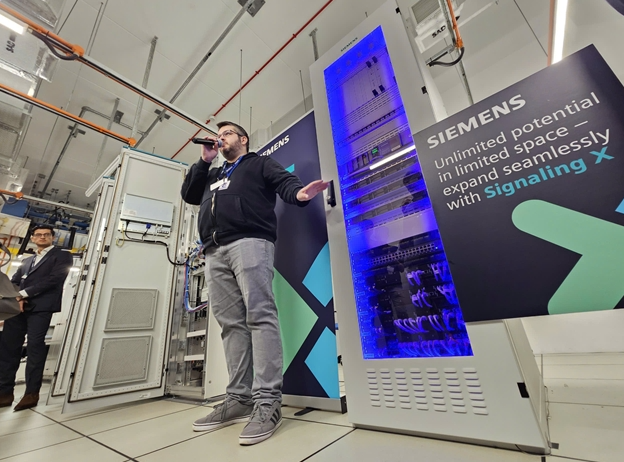
A Siemens Mobility staff presents Signaling X at the Singapore Rail Test Centre.
Signaling X is built on commercial off-the-shelf (COTS) hardware and Siemens Mobility’s Distributed Smart Safe System (DS3) platform. It enables trains to operate safely at closer intervals, potentially boosting operational efficiency by up to 20 percent and reducing energy use by up to 30 percent. These improvements can shorten wait times for passengers and lower environmental impact.
Marc Ludwig, CEO of Rail Infrastructure at Siemens Mobility, said: “Today marks a milestone in the digital transformation of mass transit as we unveil Signaling X in a live urban rail environment here in Singapore. The system brings together multiple signalling systems on one platform, expanding capabilities through open interfaces. Our solution has already proven reliable in mainline rail applications, and today is the first live demonstration in a CBTC mass transit test setting.” He added that MSI Global partnered with Siemens Mobility for the Singapore demonstration.
Siemens Mobility highlighted the growing importance of digital signalling in urban transit, particularly in fast-developing markets such as Vietnam. Cities like Hà Nội and Ho Chi Minh City are accelerating metro and urban rail projects, where data-driven infrastructure will be critical to achieving efficiency, safety, and sustainability.
Global trends also underscore the need for digital rail solutions. The world’s population is expected to reach 9.7 billion by 2050, with 68 percent living in urban areas. At the same time, the number of IoT communication interfaces is projected to reach 9.6 billion by 2032. Transport accounts for 23 percent of global greenhouse gas emissions, and Siemens Mobility said a digitally enabled rail sector is essential to meet growing mobility demand while supporting climate goals.
Signaling X integrates interlocking, signalling, and control functions on a single cloud-ready platform. Both safety-critical and non-safety systems, including timetable management and traffic optimisation, operate on the same standardised IT infrastructure, allowing a leaner and more adaptable approach to rail management. The DS3 architecture, launched in 2020, enables secure, redundant safety applications, enhances cybersecurity, simplifies maintenance, and provides a foundation for future digital rail services.
Following its debut at InnoTrans 2024 and successful mainline deployments, Signaling X is now ready for the mass transit market. Siemens Mobility noted that the technology is already in operation or being rolled out in several countries. The DS3 platform supports public interlocking applications in Austria and runs in Barcelona, Spain, with ongoing deployments in Finland and other locations in Spain, reflecting its growing global adoption.
The demonstration at Singapore signals a major advance in the digital transformation of urban rail, combining cloud-based operations, enhanced safety, and sustainable energy use, setting a benchmark for the future of metro networks worldwide.