Wedoany.com Report on Feb 24th, Membrane vesicles released during apoptosis are important biological events. Among them, apoptotic vesicles (ApoVs), a newly discovered type of small vesicles, not only inherit the characteristics of parent cells but also hold potential for applications in disease diagnosis and treatment. Real-time monitoring of the ApoV formation process, including quantity, morphology, and release dynamics, helps in analyzing apoptosis regulation mechanisms and optimizing preparation strategies. However, traditional fluorescent dyes and induction methods have limitations, making it difficult to comprehensively and dynamically track this process.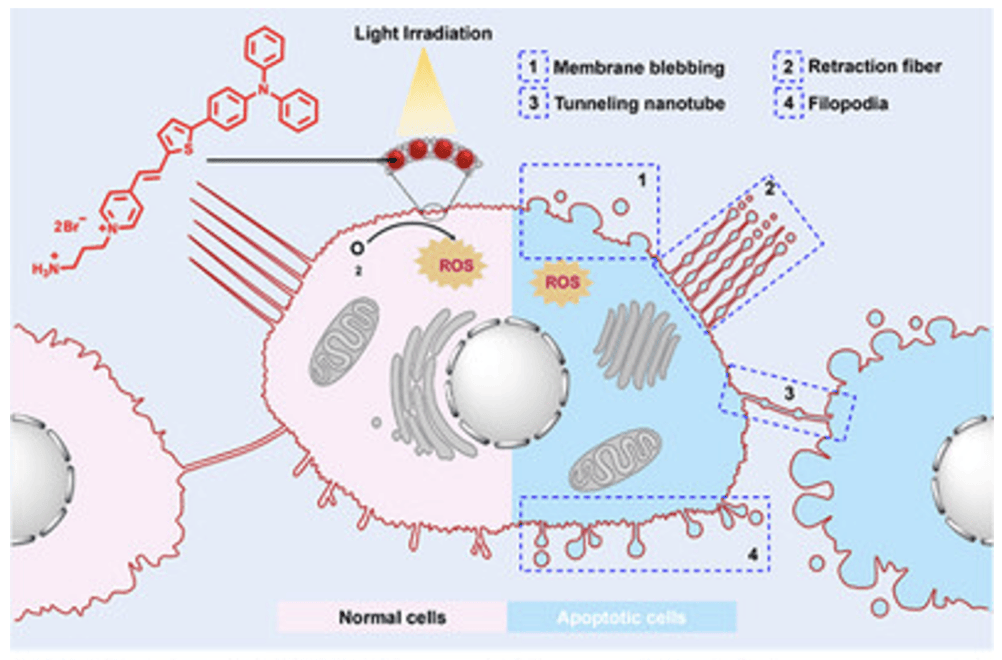
Organic photosensitizers with aggregation-induced emission (AIE) characteristics offer a new approach to address this issue. These molecules can be structurally modified to target the plasma membrane (PM) and efficiently generate reactive oxygen species (ROS) under light irradiation, thereby accelerating the apoptosis process and overcoming the delays and non-specificity issues of traditional methods. Meanwhile, AIE photosensitizers, with their high fluorescence quantum yield, low background interference, and excellent photostability, are ideal choices for long-term dynamic imaging of the plasma membrane, providing a tool for simultaneously inducing apoptosis and monitoring the entire ApoV formation process.
Researchers including Yu Xiaoqiang and Liu Zhiqiang from Shandong University and Niu Jie from Shandong Provincial ENT Hospital collaborated to develop a multifunctional AIEgen named ADTP, specifically designed for monitoring the ApoV formation process. ADTP uses a triphenylamine fluorophore as the electron donor, a thiophene unit to extend the π-conjugated system, and a hydrophilic bis-salt group that serves dual functions of PM targeting and acting as an electron acceptor. It exhibits excellent ROS generation efficiency under light irradiation, capable of producing both Type I and Type II ROS simultaneously.
In cellular experiments, ADTP specifically targeted the plasma membrane and efficiently induced apoptosis under laser irradiation, enabling fluorescence microscopy to continuously record the entire ApoV formation process. The study found that ApoVs originate from various membrane protrusions, such as filopodia, tunneling nanotubes, and retraction fibers, which may promote ApoV formation through different mechanisms.
The near-infrared emission of ADTP is compatible with stimulated emission depletion (STED) microscopy equipped with a 775 nm depletion laser, enabling high-resolution imaging to clearly visualize subtle membrane remodeling dynamics during ApoV formation. By modulating cellular conditions to induce actin- or tubulin-dominated membrane protrusions, STED imaging revealed that actin-rich protrusions tend to produce small, dispersed ApoVs, while tubulin-rich protrusions generate larger, fusible ApoVs.
The researchers stated that these high-resolution images demonstrate the effective application of ADTP as an optical tool for monitoring ApoVs originating from different membrane protrusions. This work provides a powerful tool for monitoring the complete ApoV formation process and offers key evidence for elucidating the mechanisms of ApoV formation, which is expected to advance related biomedical research.