
Non-destructive testing allows engineers to assess the integrity of structures like pipelines without dismantling them. Traditional methods rely on equipment such as speakers, but they are difficult to use in flammable or confined areas and consume significant energy. Now, a new Japanese study demonstrates a novel application of common packaging material—bubble wrap—in non-destructive testing. Led by Professor Naoki Hosoya, the research was conducted in collaboration with Shuichi Yohagi from Tokyo City University, Toshiki Shimizu and Seiwa Inadera from Shibaura Institute of Technology, and Itsuro Kajiwara from Hokkaido University. The results have been published online in the journal Measurement.
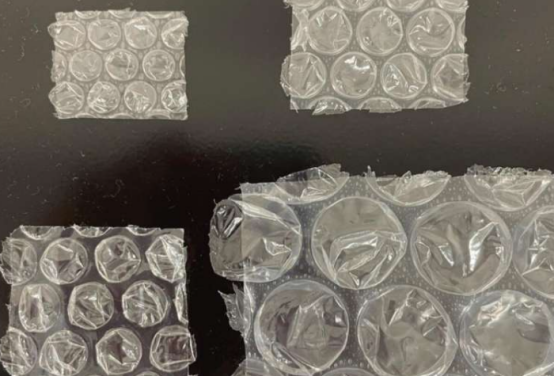
The researchers discovered that the sharp crack sound produced by popping bubble wrap can replace expensive, energy-intensive non-destructive testing tools. Professor Hosoya stated: "My team and I were looking for a simpler solution. Bubble wrap is compact, inexpensive, mass-producible, and requires no power supply, making it highly practical for construction sites." After testing the acoustic properties of various bubble wraps, they found that the popping frequency reaches up to 40kHz, sufficient for precise acoustic testing. The team built a system using bubble wrap as the sound source, with a microphone to collect signals and a computer to track reflections of sound waves inside pipes. This setup can detect objects within pipes with a 2% error margin, without needing electricity or heavy equipment.
Bubble wrap, originally a common packaging material, has gained a new scientific application in this study. By adjusting bubble size and film thickness, the sound intensity and direction can be altered, turning it into a controllable acoustic testing tool. The system is accurate and portable, requiring only a sheet of bubble wrap and a microphone to identify subtle changes in reflected sounds, revealing the location of internal obstacles with precision comparable to complex equipment. Its flexibility allows adaptation to various situations: changes in bubble size or internal pressure alter the sound frequency, making it applicable to pipes of different diameters and materials. Setup is simple, and operators can be trained in a very short time to perform detections.
The team plans to conduct further tests under different temperatures and pressures, exploring the development of a compact handheld system. Ongoing improvements are expected to enhance sensitivity, enabling detection of deeper or more complex structures.