
A research team from the Niels Bohr Institute at the University of Copenhagen has published findings in Physical Review Letters, successfully observing a special state between superconducting and insulating phases through precise control. This discovery provides new experimental evidence for quantum materials research.
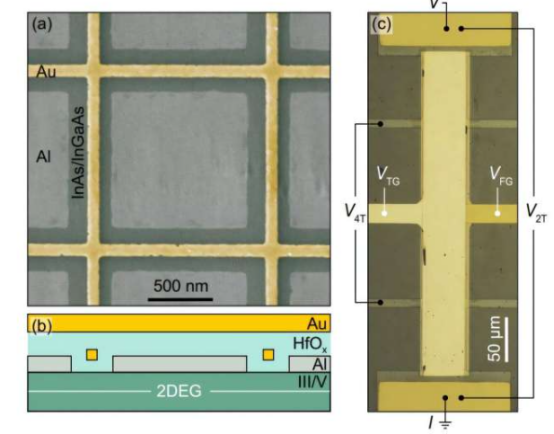
Led by Associate Professor Saulius Vaitiekenas, the team constructed an array of miniature superconducting islands, each equipped with independent voltage control. This design allowed researchers to precisely tune the quantum correlation strength between islands. Experimental results showed that, as the system transitioned from a superconducting to an insulating state, an intermediate state emerged that was neither superconducting nor fully insulating. Vaitiekenas stated: "Our research further reveals this state, indicating that quantum fluctuations—or more precisely, the uncertainty between the superconducting phase across islands and the particle number within islands in our sample—lead to this behavior."
This new state, known as an anomalous metal state, exhibits unique behavior of quantum materials during phase transitions. By tuning the coupling strength between superconducting islands, the research team observed that communication between islands was maintained, but the system as a whole did not exhibit superconducting properties. This finding offers a new perspective on understanding quantum phase transition mechanisms and holds reference value for developing novel quantum devices.
Vaitiekenas noted: "Understanding this quantum phase transition is like solving a giant puzzle. Fitting one piece at a time may not reveal the full picture, but in the long run, it could be a step toward more energy-efficient electronics and more controllable, reliable quantum devices, preparing for future applications." The research was conducted by multiple researchers, including collaborators Satyaki Sasmal and Maria Efthymiou-Tsironi.
Quantum materials research continues to reveal new properties of matter, and this experimental discovery of a special state opens new pathways for exploring quantum state control. The findings are expected to advance technological development in fields such as quantum computing and quantum sensing.