
Assistant Professor of Physics Wenxiao Ge at the University of Rhode Island, in collaboration with Kurt Jacobs, a quantum technology physicist at the U.S. Army Research Laboratory, has achieved significant results in the field of quantum sensing. The research focuses on enhancing quantum sensing capabilities to make detection data more precise, with findings recently published in Physical Review Letters.
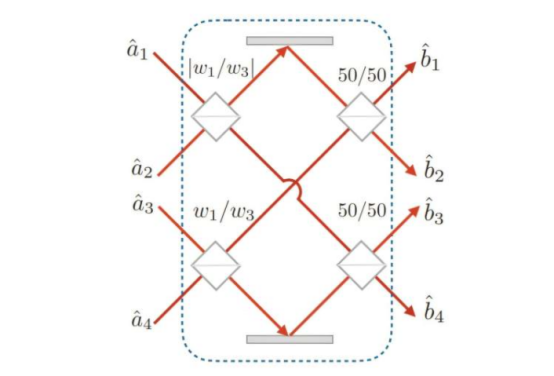
Professor Ge's paper, "Heisenberg-Limited Distributed Quantum Metrology with Continuous Variables and Arbitrary Weights," released in September, delves deeply into network quantum sensing technology, particularly advanced sensors in entanglement networks. This technology holds promise for improving the precision of measurements, navigation, and world exploration, such as enhancing measurements by sensing changes in motion, electric fields, or magnetic fields. Entanglement networks, as a non-classical network, have sensor characteristics that cannot be described individually, and Professor Ge's research emphasizes achieving the Heisenberg limit—the fundamental limit of quantum-enhanced sensing, allowing estimates with precision surpassing classical methods.
The study reveals that a single minimalist device can construct a useful entanglement network and achieve the Heisenberg limit using two single-mode quantum states. Professor Ge noted that the device can measure the "phase shift" function, thereby improving the precision of distance or other complex signal measurements. This means that enhancing quantum sensitivity when using GPS will yield more accurate destination information. Professor Ge explained: "It can make GPS and time estimation more precise. Everyday GPS can only locate within a 10-meter radius, but with this technology, we can predict distances more accurately."
Professor Ge has long been dedicated to theoretical quantum optics and quantum information research, exploring the fundamental limits of quantum mechanics in information acquisition, transmission, and processing. This research is part of a three-year funded project he received in 2022, aimed at exploring non-classical states in quantum metrology through quantum resource theory. Professor Ge believes that the development of quantum metrology will deepen understanding of basic principles of nature and drive advancements in national security and technology.