
An international research team led by the Leibniz Institute for Astrophysics Potsdam has provided new evidence for the existence of dark matter through observations of dwarf galaxies. The study analyzed stellar motion data from 12 of the smallest and darkest galaxies in the universe, challenging the modified Newtonian dynamics theory.
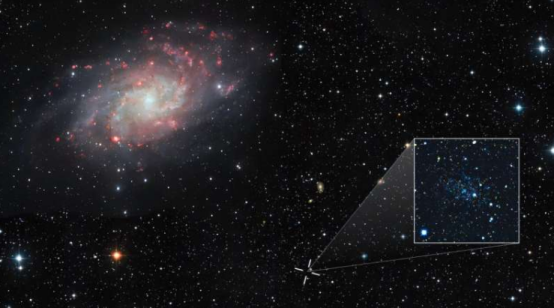
The research team used the UK's DiRAC National Supercomputing Facility for simulations, comparing observational data with predictions from dark matter models and modified Newtonian dynamics theory. The results show that the gravitational fields inside dwarf galaxies cannot be reasonably explained by visible matter alone. First author Mariana Julio, a PhD student at the Leibniz Institute for Astrophysics Potsdam, stated: "Both the observational results and our EDGE simulations indicate that their gravitational fields cannot be determined solely by visible matter, which contradicts modified gravity predictions."
This study questions the long-standing "radial acceleration relation" hypothesis. The findings reveal that in the smallest dwarf galaxies, the simple relationship between the amount of visible matter and gravitational strength begins to break down. Co-author Dr. Marcel Pawlowski noted: "Our results confirm previous suspicions that the motion trajectories of dwarf galaxies do not match expectations for larger mass galaxies. They are inconsistent with the extrapolated radial acceleration relation but show greater acceleration."
Professor Justin Read from the University of Surrey added: "New data and modeling techniques allow us to map gravitational fields on smaller scales than ever before. If these galaxies are surrounded by an invisible dark matter halo, this result can be explained." These observational results provide new directions for dark matter research, although they do not yet reveal the specific composition of dark matter, they significantly narrow the space for other theoretical explanations.
The research findings have been accepted by the Astronomy & Astrophysics journal and released on the arXiv preprint platform. Future observations of even fainter galaxies will continue to advance the exploration of the nature of dark matter.