
The research team led by Dr. Cao Shengding from the Smith School of Engineering at Queen's University in Canada has made progress in the field of carbon dioxide conversion technology by developing a novel dynamic synthesis and recovery method for catalysts, enhancing the long-term operational stability of the system. This research achievement in carbon dioxide conversion technology provides a new path to address the catalyst degradation issues in carbon conversion processes.
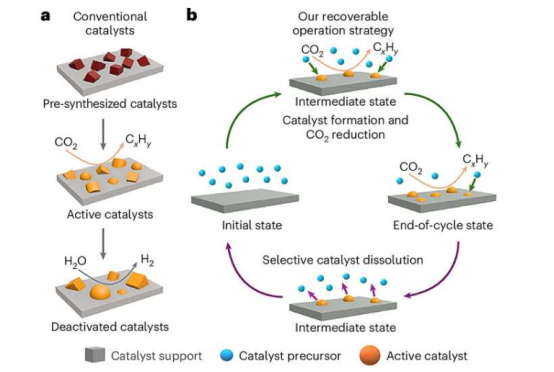
The research team replaced traditional copper-based catalysts with catalyst precursors, generating active substances in situ through electrical signals during the electrochemical reaction process. The project leader stated: "Repeating this cycle ensures selectivity and stability over a longer period. This is one of the most stable carbon conversion systems to date." When the system is paused, the catalyst automatically reverts to its precursor form, and upon restart, catalyst regeneration can be completed within seconds.
This novel carbon dioxide conversion technology supports intermittent operation modes, enabling system coupling with renewable energy sources such as solar and wind power. A research team member pointed out: "Methane has extremely high energy density, which is crucial for energy storage applications. Its seamless compatibility with existing natural gas infrastructure makes it ideal for large-scale and long-term energy solutions." The technology is currently mainly applied to converting carbon dioxide into clean fuels such as methane.
The research results have been published in the journal Nature Energy, and the research team plans to next expand this carbon dioxide conversion technology to the production of more high-value chemicals such as ethylene and ethanol, while advancing engineering scale-up studies of the technology. This technological breakthrough, completed through collaboration with multiple international research institutions, provides new technical support for the resource utilization of carbon dioxide.