
A collaborative research team from IMDEA Materials Institute, Northwestern Polytechnical University in China, the Chinese Academy of Sciences, Peking University, and Southern University of Science and Technology has proposed an innovative design method in the field of mechanical metamaterials. This study, published in Nature Communications, demonstrates an irregular growth strategy that achieves static mechanical invisibility and camouflage functions through disordered structural materials.
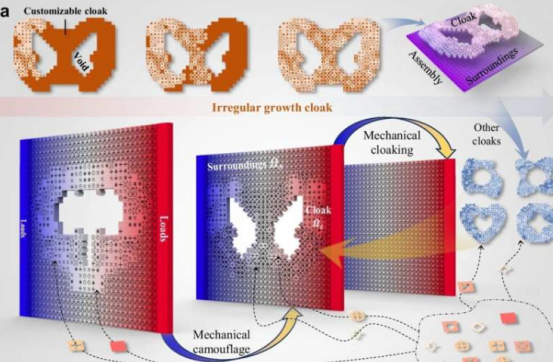
The properties of mechanical metamaterials are primarily determined by geometric construction rather than material composition. Traditional designs often rely on periodic structures, while biological materials in nature, such as bones and insect wings, exhibit superior mechanical performance through irregular structures. Inspired by this, the research team's irregular growth strategy breaks through conventional design paradigms, enabling internal voids in materials to exhibit solid-like mechanical behavior and even simulate the mechanical responses of other shapes.
Mechanical invisibility technology allows internal defects or cavities in materials to go undetected under load, while the camouflage function enables one structure to mimic the mechanical characteristics of another. The research team assembles basic units with variable stiffness using probabilistic growth rules to construct mechanical cloak structures that maintain performance under complex boundary conditions and different void shapes. The framework structures formed by this irregular growth strategy demonstrate stable camouflage capabilities under non-uniform loads or irregular environments.
Researchers utilized 3D printing technology to fabricate prototypes, experimentally verifying the consistency between simulation results and measured data. The application of this irregular growth strategy has been extended to three-dimensional domains. In soft robotics technology, the camouflage function can help components conceal structural features; in biomedical devices, materials can simulate the tactile responses of human tissues. This design method based on irregular growth strategies can also be applied to fields such as vibration control, tunnel reinforcement, and haptic feedback.
This study overcomes the limitations of traditional transformation optics methods in static mechanics, achieving mutual camouflage between different void shapes for the first time. The irregular growth strategy provides a new direction for mechanical metamaterial design, promoting the practical application of invisibility and camouflage technologies.