
Astronomers have revealed the formation mechanism of the periodic flash phenomenon in galaxy OJ 287 through the latest simulation study. This black hole simulation research provides the first comprehensive numerical simulation of the OJ 287 galaxy, located 3.5 billion light-years away, offering a new perspective on understanding its regular flashes.
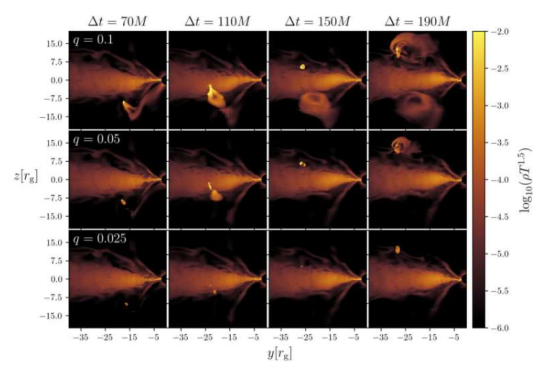
Led by postdoctoral researcher Sean Ressler at the Canadian Institute for Theoretical Astrophysics, the research team published a paper in The Astrophysical Journal Letters, analyzing the interaction between a pair of supermassive black holes in the galaxy via black hole simulation. Ressler stated, "Systems like this provide a rare opportunity to study how galaxies merge and grow over time." The black hole simulation comprehensively considers the complex interactions of extreme gravity, electrodynamics, and fluid dynamics.
The study shows that the OJ 287 system contains a primary black hole with a mass equivalent to 18 billion solar masses and a secondary black hole with a mass of 150 million solar masses. This black hole simulation system confirms that the periodic impacts of the secondary black hole on the gas disk surrounding the primary black hole are the main cause of the flashes. Collaborator Luciano Combi noted, "This is the first overall simulation of the gas around a binary black hole." The simulation-generated animation intuitively demonstrates the interaction process between the black hole and the accretion disk.
This black hole simulation not only verifies the theory that collisions produce flashes but also reveals the patterns of changes in the accretion disk structure. Collisions cause the gas disk to form an inward-tilting spiral pattern, a structural change that was not fully recognized in previous studies. Ressler added, "These calculations should be seen as the first step toward a fully realistic simulation." The research team's black hole simulation provides an important foundation for understanding supermassive binary black hole systems.