
A team led by Dr. Kenneth Merz at the Cleveland Clinic's Center for Computational Life Sciences has demonstrated how quantum computers can be used to study molecular behavior in aqueous solutions.
One of the most critical aspects of chemistry is understanding how molecules react in specific liquids. For instance, in water-based solvent solutions, molecules interact with surrounding water molecules, altering their behavior. If researchers can predict these changes in liquids, they could develop more effective drugs and treatments.
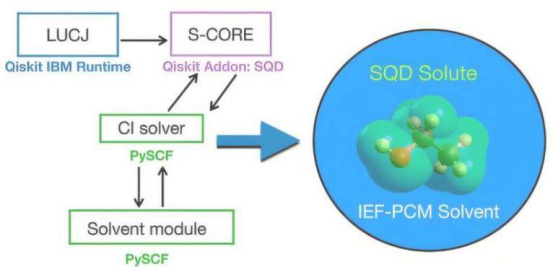
However, calculating all possible reactions and outcomes for each molecule in a solvent is too time-consuming and costly for current methods on classical computers. To address this challenge, the Merz lab conducted the first study to use Sample-Based Quantum Diagonalization (SQD) on real quantum hardware to demonstrate implicit solvent simulations, offering a new approach to better characterize molecules in solution.
The paper, published in a special issue of The Journal of Physical Chemistry, is the first to test SQD in the solvent phase and was selected as the cover story for the issue.
To understand molecular behavior in liquids, Dr. Merz and his team used IBM Quantum System One to run SQD, which selects "samples" of a molecule's electronic configurations to help characterize its energy. These samples are then sent to a classical computer for analysis, selecting the most likely outcomes.
This process is repeated and refined until the most accurate prediction is achieved. As part of a collaboration with IBM, Cleveland Clinic has access to IBM Quantum System One, the first quantum computer dedicated to healthcare research.
To validate the model, the research team tested four common polar molecules in chemistry and biology: methanol, ethanol, methylamine, and water. Each test used up to 52qubits, achieving chemical accuracy below 1kcal/mol. These results demonstrate that the model can predict molecular energy and solvation free energy.
"This study is a significant step toward practical quantum chemistry on quantum computers," said Dr. Merz. "Hybrid quantum models remain largely unexplored, and few have been tested on quantum hardware. By testing this model on quantum hardware, we have demonstrated its ability to leverage quantum computing to advance chemical research."