
A research team from the University of Texas at Austin, Los Alamos National Laboratory, and Type One Energy Group has discovered a faster and more accurate method to repair magnetic field defects in fusion reactions, addressing the longstanding challenge of locating particle leaks in stellarators. Researchers describe this advance as a paradigm shift in fusion reactor design, potentially speeding up stellarator development by a factor of 10. The related paper was recently published in Physical Review Letters.
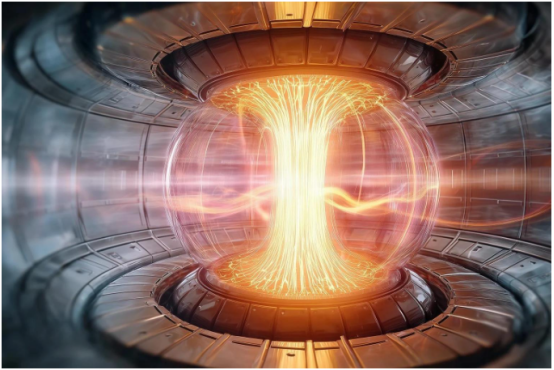
The stellarator concept, proposed in the 1950s, is a ring-shaped fusion reactor design that relies on precisely engineered external windings to control internal magnetic fields, thereby confining plasma and high-energy particles. This confinement system is often described as a "magnetic bottle."
One major challenge hindering fusion energy progress is how to confine high-energy particles within the reactor. When high-energy alpha particles leak from the reactor, the plasma fails to reach the high temperatures and densities required to sustain fusion reactions.
However, these magnetic fields often contain invisible "gaps," through which alpha particles can escape. Traditional methods based on Newton's laws can identify these gaps in the magnetic bottle but require enormous computational resources and time. Moreover, designing a stellarator involves simulating and testing hundreds of magnetic coil variants, making the process extremely cumbersome.
To save time and money, scientists and engineers typically use a simpler approximation called perturbation theory to estimate gap locations. However, this method lacks accuracy, slowing stellarator development. The new approach proposed by the research team relies on symmetry theory, offering a fresh perspective on understanding the system.
Using this method, the team can more accurately map potential particle leakage points, providing a powerful tool to enhance reactor safety and efficiency. The team states that while magnetic fusion design still faces other major challenges, this progress resolves the largest problem that has persisted since stellarators were first proposed over 70 years ago.
Notably, this new method also helps address a similar but distinct issue in another popular magnetic confinement fusion reactor design, the tokamak. In tokamaks, runaway electrons can punch holes in surrounding walls. This approach can identify gaps in the magnetic field where these electrons might leak.