
A joint research team from the Korea Advanced Institute of Science and Technology (KAIST) and the Korea Research Institute of Bioscience and Biotechnology has published their latest findings in the journal Nature Aging, successfully developing a new technology called "FiNi-seq" (Fibrosis Niche Sequencing). This innovative technology can precisely capture changes in the fibrotic microenvironment within aging liver tissue, offering a new tool for the early diagnosis and treatment of chronic liver diseases.
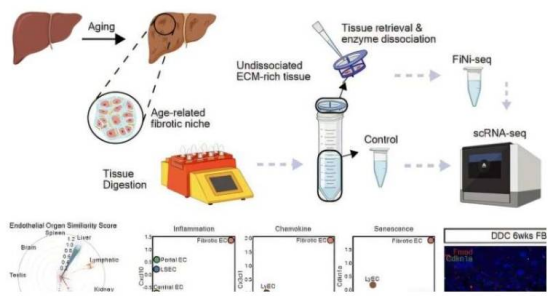
Led by Professor Jong-Eun Park from KAIST and Dr. Chuna Kim from the Korea Research Institute of Bioscience and Biotechnology, the research team physically screened regions in aging liver tissue with high resistance to tissue degradation, successfully enriching early aging microenvironments characterized by delayed regeneration and fibrosis accumulation. "Through this research, we can precisely elucidate the cellular composition and spatial characteristics of fibrotic microenvironments observed in aging liver tissue at the single-cell level," said Dr. Kim.
The technology achieved several breakthrough discoveries:
Identification of specialized endothelial cells associated with fibrosis
Discovery of fibroblasts interacting with the immune system
Detection of immune-exhausted cells, such as PD-1 highly expressing CD8 T cells
The study confirmed that specific cells in fibrotic regions of aging liver tissue secrete factors that cause secondary aging in the surrounding environment. Professor Park noted, "As an analytical technology capable of capturing subtle changes occurring in the early stages of aging and chronic diseases, it holds significant potential for identifying effective therapeutic targets in the future."
By integrating transcriptomic and epigenomic data, the team accurately interpreted the spatial heterogeneity of the aging liver microenvironment and identified its association with intrahepatic vascular structures. This technology is expected to be applied to research on chronic diseases in other organs, such as the lungs and kidneys, in the future.