
A research team from the University of Michigan's Department of Physics has published findings in Physical Review X, revealing that a class of optical materials known as topological insulators offers far broader design possibilities than previously expected. This discovery could provide more material options for future optical technologies such as lasers, detectors, and imaging devices.
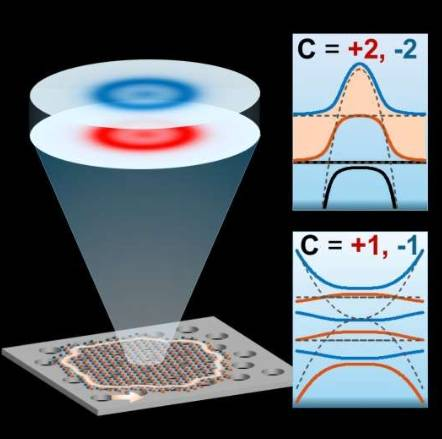
Through symmetry analysis and computer simulations, the team found that various photonic crystal structures can achieve topological insulators with unidirectional light transmission. Lead author Xin Xie stated: "This is an important step toward building a stronger foundation for photonic technologies." The study breaks through the traditional view that the design space for such materials is limited.
Traditional topological insulator research primarily relies on external magnetic fields to induce properties, whereas the Michigan team explored alternatives that do not require magnetic fields. Senior author Professor Hui Deng noted: "Our approach enables larger bandgaps, better protecting edge conduction states." Simulations show that certain common photonic crystal structures combined with two-dimensional materials can form high-performance polariton Chern insulators.
"The most surprising aspect is that the required band structure is actually very common," Xie added. The researchers predict that experimentally prepared samples could achieve bandgaps approximately 100 times larger than current records, significantly enhancing optical device performance. The team's next step is to translate simulation results into physical samples.