
A research team from the University of Massachusetts Amherst has recently achieved significant progress in computer vision using novel silicon-based hardware. This hardware captures and processes visual data in the analog domain, offering new solutions for large-scale, data-intensive, and latency-sensitive computer vision tasks. The findings were published in Nature Communications.
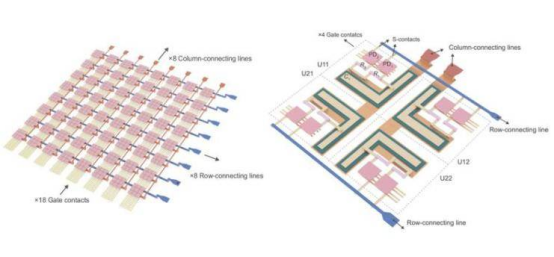
Team leader and associate professor of electrical and computer engineering, Guangyu Xu, stated: "Our retina-inspired hardware design integrates sensing and processing units at the device level, closely mimicking how the human eye processes visual information." He further explained that traditional computer vision systems often involve redundant data exchange between sensing and computing units, whereas the new hardware effectively reduces this redundancy, improving processing efficiency.
Professor Xu noted that current computer vision systems, when processing images, often transmit and handle large amounts of information beyond actual needs, leading to processing delays. Their technology aims to shorten the time gap between perceiving the physical world and recognizing captured content. The team created two integrated gate-tunable silicon photodetector arrays to separately capture and recognize dynamic visual information and spatial features of static images.
Experimental results show that this new analog technology achieves up to 90% accuracy in processing dynamic motion, outperforming traditional digital methods; for static images, it reached 95% accuracy in classifying handwritten digits. Additionally, since these silicon arrays use materials common in computer chips, they are highly compatible with existing CMOS technology, making them particularly suitable for large-scale computer vision tasks.
Professor Xu also highlighted potential applications, including autonomous vehicles and biological imaging. He emphasized that reducing processing time is crucial for enhancing the safety of self-driving cars, while in biological imaging, the new technology could compress data volumes while providing scientists with the same biological insights.