
Yale University astronomers may have uncovered the origin of one of the universe's most striking phenomena—double hot Jupiters—and have devised a plan to search for more such occurrences.
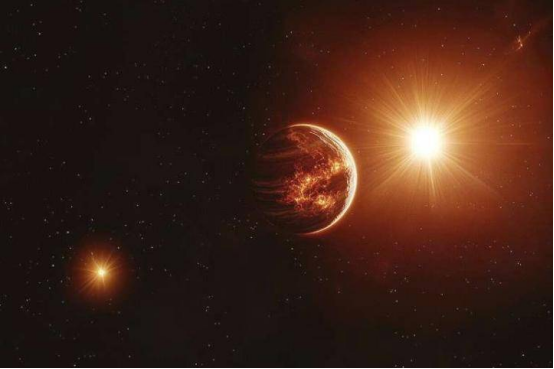
Hot Jupiters are massive, extremely hot planets (with temperatures up to 3,000°F), roughly the size of Jupiter or Saturn. Their orbits are so close to their host stars that they complete a revolution in less than a day.
The first hot Jupiter, discovered in 1995 (named 51 Pegasi b), earned two Swiss astronomers the 2019 Nobel Prize in Physics and sparked a wave of exoplanet discoveries that continues to this day.
Hot Jupiters are a rare class of planets, orbiting only about 1% of stars. Double hot Jupiters are even rarer, occurring in binary star systems—solar systems where two stars orbit each other—with a hot Jupiter forming around each star.
In a new study published in The Astrophysical Journal, Yale astronomer Malena Rice and her team demonstrate that the normal, long-term evolution of binary star systems can naturally lead to the formation of a hot Jupiter around each star.
This process is formally known as von Zeipel-Lidov-Kozai (ZLK) migration. The ZLK mechanism posits that, over long periods, planets with unusual orbits or angles may be influenced by the gravitational pull of a more distant secondary body. Rice explains that, in this case, this mechanism can lead to the formation of hot Jupiters.
"The ZLK mechanism is like a dance," said Rice, Assistant Professor of Astronomy at Yale's Faculty of Arts and Sciences. "In a binary system, the additional star can shape and distort a planet’s orbit, causing it to migrate inward."
"We show how planets in a binary system can undergo a mirrored migration process, resulting in both stars ultimately hosting hot Jupiters."
Yurou Liu, a rising senior at Yale University and the study's first author, explained that the researchers conducted numerical simulations to demonstrate the evolution of two stars and two planets in binary system configurations.
"With the right code and sufficient computational power, we can explore how planets evolve over billions of years—motions that no human lifetime could observe, but that still leave observable signatures," Liu said.
Regarding hot Jupiters, Liu noted that their existence challenges prior assumptions about planet formation, making their formation mechanism particularly intriguing. "We expect giant planets to form far from their host stars," she said. "This makes hot Jupiters both intuitive and mysterious, a topic worth studying."
The research team also proposed a strategy for finding double hot Jupiters: targeting dozens of already discovered hot Jupiters located in systems with a nearby second star.
"Our proposed mechanism works best when the stars are at a moderate distance from each other," said Tiger Lu, a co-author who earned a PhD in astrophysics from Yale this spring. "They need to be far enough apart for giant planets to still be expected to form around each star, but close enough for the two stars to influence each other over the system's lifetime."