
Researchers at École Polytechnique Fédérale de Lausanne (EPFL) have developed a customizable soft robotic system that uses compressed air to produce shape changes, vibrations, and other tactile feedback across various configurations. The device holds significant potential for applications in virtual reality, physical therapy, and rehabilitation.
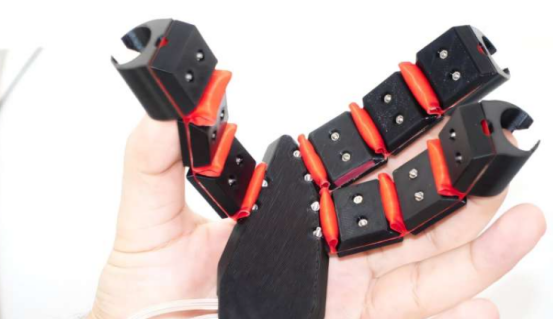
Despite its flexible and relatively complex 16 configurations, the Digits framework, developed by EPFL's School of Engineering Reconfigurable Robotics Lab, has a relatively simple design. Each configuration consists of multiple modules (or Digits) made of rigid links connected by flexible joints. These joints are controlled by pressurized airbags to alter the module’s shape and stiffness.
In a recent study published in Advanced Intelligent Systems, Reconfigurable Robotics Lab director Jamie Paik and her team showcased two Digits configurations—wearable TangiGlove and handheld TangiBall—demonstrating the framework’s versatility.
"Tactile interfaces can enhance virtual reality experiences by simulating real-world touch and support rehabilitation through interactive systems. But we need more versatile reconfigurable designs and control methods," explained doctoral student and first author Serhat Demirtas.
Thanks to its modular design, the Digits framework offers broad application potential, including progressive muscle training, motor recovery, and diverse configurations for tactile interfaces in virtual environments.
Matching the Rich Sensory Experience of Human Touch
Unlike other human senses like vision and hearing (which are largely passive), touch requires complex actions such as friction or grasping to perceive texture, temperature, weight, shape, or hardness. As a result, haptic technologies are typically developed for single purposes or specific tactile aspects, as creating systems that are adaptable, scalable, and capable of realistic tactile experiences is highly challenging.
The Digits framework, leveraging Paik's lab's signature reconfigurable robotics technology, successfully addresses this challenge. Notably, it encompasses two major categories of robotic structures: closed-chain and open-chain. Open-chain structures consist of a series of connected links fixed at one end, resembling a robotic arm, while closed-chain structures typically feature a loop design fixed at both ends.
Thus, the open-chain TangiGlove functions like an exoskeleton, providing stiffness feedback to the wearer. Meanwhile, the closed-chain TangiBall, with four connected Digits, can offer stiffness feedback and display up to eight different shapes—from cubes to spheres. Both devices can generate vibrations.
Beyond its modular design, the Digits framework stands out for its focus on pneumatic (compressed air) actuation, an underexplored area in robotics for personalized tactile experiences. To bridge this gap, the scientists expanded the open-source robotic software Feelix, enabling users to create custom pneumatic tactile interaction profiles. The machine-learning-based system can detect changes in Digits modules caused by touch and create new, intelligent, intuitive interactions without any coding.
The team has already planned to develop the technology's rehabilitation potential by evaluating therapeutic scenarios and long-term usability. They are also exploring broader applications through new configurations, particularly those that leverage the device’s ability to rapidly switch between different sizes, shapes, and stiffness levels—a prerequisite for real-time interactions in virtual and augmented environments.
"Our goal in developing the Digits modules is to redefine human-machine interaction through reconfigurable robots that can adjust their shape, stiffness, and tactile feedback. This adaptability enables more realistic virtual reality, more effective rehabilitation, and richer experiences for everyone—regardless of their size, abilities, or needs," Paik emphasized.