
A research team led by Professor Chen Deyong and Professor Wang Junbo from the Aerospace Information Research Institute of the Chinese Academy of Sciences has developed a new type of micro-sensor that significantly improves the accuracy and measurement range of vacuum pressure detection. The research results have been published in the journal Microsystems & Nanoengineering.
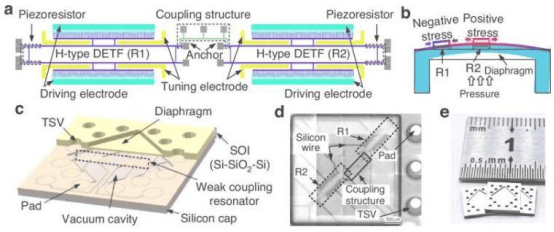
Wide-range vacuum sensors play a crucial role in various high-tech fields. For example, in the semiconductor industry, precise pressure control is essential for processes such as chemical vapor deposition and plasma etching. However, existing sensor technologies face a trade-off between measurement range and accuracy: Pirani vacuum gauges offer a broad range but insufficient precision, while capacitance diaphragm gauges (CDG) provide high accuracy but have a limited measurement range. Composite sensors combining both technologies are bulky, structurally complex, and sensitive to gas types.
To address these challenges, the team developed a micro-electro-mechanical system (MEMS) pressure sensor. It integrates two resonant working modes into a single sensing element on one chip, enabling smooth operation across six orders of magnitude (from 0.3Pa to 100,000Pa). In the low-pressure range (0.3Pa to 1,000Pa), it uses a “mode localization” mode that amplifies tiny pressure changes into easily detectable signals. In the high-pressure range (1,000Pa to 100,000Pa), it automatically switches to the conventional resonant mode, which offers high accuracy and excellent stability.
This dual-mode design delivers outstanding performance. The sensor achieves a resolution of approximately 0.1Pa in low-pressure environments and about 2.0Pa in high-pressure environments. Calibration errors are extremely small: the relative deviation at 120°C in the low-pressure range is 1.99%, while in the high-pressure range it is as low as 0.01% of full scale. Additionally, it operates reliably across a wide temperature range from -20°C to 120°C and is insensitive to different gas types.
All of these functions are integrated into a compact MEMS chip with a volume of only 27.2 cubic millimeters—more than 200 times smaller than traditional commercial sensor chips.
This research provides valuable insights for applications in semiconductor manufacturing, space missions, and high-precision engineering.