
Researchers in Arkansas have developed a system that surpasses human discernment in measuring plant stress caused by herbicides by combining artificial intelligence with sensors beyond visible light. Scientists from the Arkansas Agricultural Experiment Station—the research arm of the University of Arkansas System Division of Agriculture—published a study in +, providing proof of concept for the application of hyperspectral sensors in weed management.
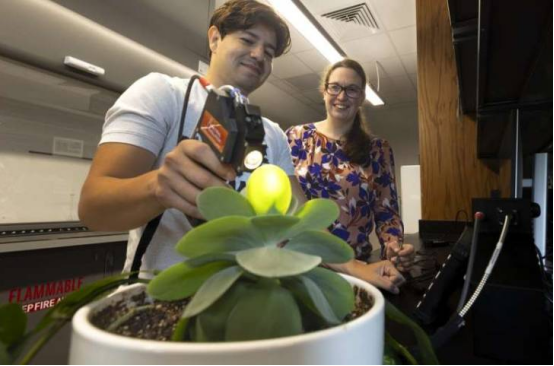
Weed management is a critical component of agricultural production, and quantifying herbicide effectiveness is a key element in suppressing herbicide resistance. Ordinary cameras use only red, green, and blue visible light bands to create images, with a spectral range of 380 to 750 nanometers; hyperspectral sensing captures bands from 250 nanometers to 2500 nanometers and thermal infrared, providing richer information.
In this study, the researchers used hyperspectral sensing technology to evaluate the response of lambsquarters (Chenopodium album L., a common weed in agricultural and horticultural environments) to glyphosate. Surprisingly, they found that when lambsquarters was exposed to sublethal doses of the herbicide, its photosynthesis was actually enhanced.
"Plant responses to herbicide applications are traditionally measured through visual ratings, but accuracy can be affected by the quality of rater training and years of practical experience," said the study's lead researcher, Aurelie Poncet, assistant professor of precision agriculture in the Department of Crop, Soil, and Environmental Sciences at the University of Arkansas and the Dale Bumpers College of Agricultural, Food and Life Sciences. "We believe that if we can have a sensor that automatically makes some decisions, it may enable more precise assessments in future applications."
Trained weed scientists can control herbicide efficacy assessment errors to within 10% (±5%). In this study, the researchers used machine learning models to analyze data collected by a spectroradiometer, ultimately controlling the error to 12.1%, with a goal of further reducing it below 10%.
During the research, the team used the random forest machine learning algorithm to analyze thousands of vegetation index data points collected in the experiment. The algorithm combines the outputs of multiple decision trees to produce a single result. Lead author Mario Soto, a master's student in crop, soil, and environmental sciences at Bumpers College, stated: "We successfully used random forest to describe the response of lambsquarters to glyphosate application, which opens possibilities for advancing beyond vegetation indices—a method gaining increasing attention in published literature."
Once perfected, this hyperspectral sensing technology can be used to measure the response of specific weeds to herbicide applications, overcoming the limitations of human visual assessment. Nilda Roma-Burgos, professor of weed physiology and molecular biology at the Experiment Station and Bumpers College, noted that while training can compensate for a lack of experience among evaluators, mental and physical fatigue from prolonged assessment of treatment plans under harsh environmental conditions can affect judgment. "In principle, this method can eliminate human factors in herbicide efficacy assessment, becoming a valuable research tool in weed science. However, significant work is still needed to validate the method's effectiveness across major weed species, herbicide modes of action, time after herbicide application, and environmental conditions."
Co-authors of the study also include University Professor of Applied Soil Physics and Pedology Kristofor Brye, project assistant Wesley France, and graduate research assistant in weed science Juan C. Velasquez from the Department of Crop, Soil, and Environmental Sciences.