
A research team at the U.S. Oak Ridge National Laboratory (ORNL) has recently developed a machine learning-based method that efficiently and accurately predicts the key thermodynamic properties of molten salt materials, providing a vital tool for nuclear energy technology development. The research findings were published in the journal Chemical Science.
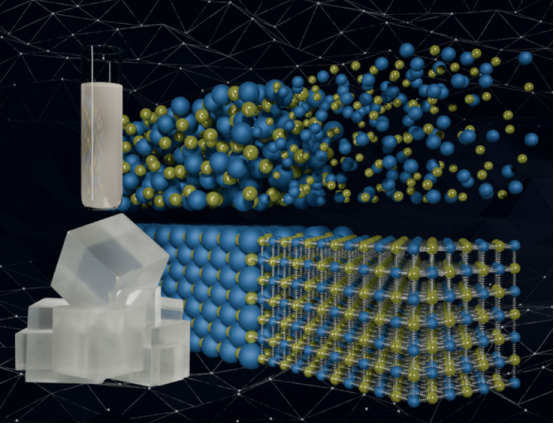
Molten salts are highly valuable in nuclear energy applications due to their high-temperature stability and chemical compatibility, such as in nuclear fuel dissolution and improving long-term reactor operational reliability. However, traditional experimental methods and computational models face challenges including high costs, lengthy durations, and insufficient accuracy when predicting molten salt properties. The ORNL team combined quantum chemistry calculations with artificial intelligence, leveraging the powerful computing capabilities of the Summit supercomputer to achieve rapid simulations of the thermodynamic properties of molten salts in both liquid and solid states, significantly enhancing prediction efficiency and accuracy.
Team member Luke Gibson stated, "The innovation of this method lies in its simplicity. Compared to traditional models, machine learning requires fewer computational steps to achieve higher accuracy, opening a new path for molten salt property research."
The study highlights that precise modeling of molten salt properties is crucial for the design of next-generation nuclear reactors, safety assessments, and nuclear waste management. Through low-cost, high-accuracy simulation technology, researchers can more efficiently optimize reactor operating parameters, reduce experimental costs, and accelerate the development of new nuclear energy systems.
ORNL materials scientist Emily Tomlin emphasized, "Large-scale, cost-effective, and precise molten salt modeling serves as a bridge connecting experimental data with engineering applications. This breakthrough will drive nuclear energy technology toward safer and more efficient directions."
Currently, the team is further expanding the application scope of the machine learning model, planning to apply it to property predictions for more complex nuclear energy material systems, providing technical support for the global nuclear energy industry upgrade.