
A research team from the Faculty of Physics at the University of Warsaw, in collaboration with the Military University of Technology and Université Clermont Auvergne, has achieved a significant breakthrough in optical microcavity technology. The findings, published in Laser & Photonics Reviews, provide an innovative platform for photon engineering and quantum optics research.
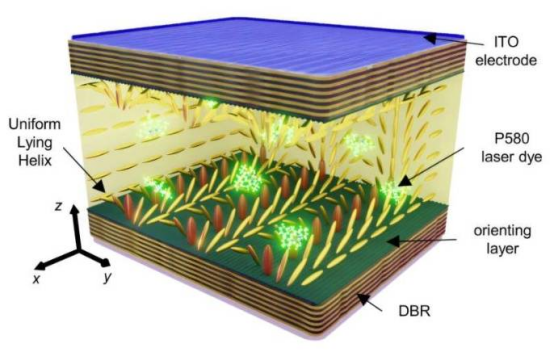
The team utilized the self-organizing properties of cholesteric liquid crystals (ChLC) to successfully construct a novel optical microcavity system. This system can form and dynamically control photonic crystal structures with integrated spin-orbit coupling (SOC) while achieving controllable laser emission. Project leader Professor Jacek Szczytko from the University of Warsaw's Faculty of Physics explained, "The uniform helical structures we designed are self-organized by pencil-like liquid crystal molecules, exhibiting unique optical properties."
Cholesteric liquid crystal molecules spontaneously arrange into helical structures within the microcavity, with the molecular layer orientation exhibiting periodic twisting, similar to the DNA double helix. The team from the Military University of Technology, led by Professor Wiktor Piecek, developed specialized liquid crystal mixtures. He stated, "Achieving large-area uniform helical structures is a major challenge in materials engineering. Our technology allows precise control of the helical pitch, thereby tuning the photonic band structure."
Key innovations in the study include:
Real-time tuning of the photonic band structure via electric fields
Observation of interband spin-orbit coupling (ISOC) effects
Achievement of dual-wavelength laser emission
System area reaching hundreds of square micrometers
The research team also introduced organic dyes into the system, successfully observing linear and circularly polarized dual-laser phenomena. Co-author Dr. Piotr Kapuściński noted, "These discoveries hold both fundamental research value and practical application potential."
The theoretical team from Université Clermont Auvergne provided explanations for the experimental phenomena. Professor Guillaume Malpuech stated, "This novel microcavity system offers an ideal platform for studying cutting-edge topics such as topological photonics and non-Abelian gauge fields."
Potential applications of this technology include:
Tunable lasers
Optical sensors
Quantum information processing
Topological photonic devices