
A team led by Professor Hirohide Saito and Assistant Professor Hirohisa Ohno at the Research Center for Advanced Science and Technology, The University of Tokyo, has published groundbreaking results in Nature Communications, successfully developing a novel "split RNA switch" system. By integrating translational and post-translational control mechanisms, this technology enables highly specific regulation of gene expression in target cells.
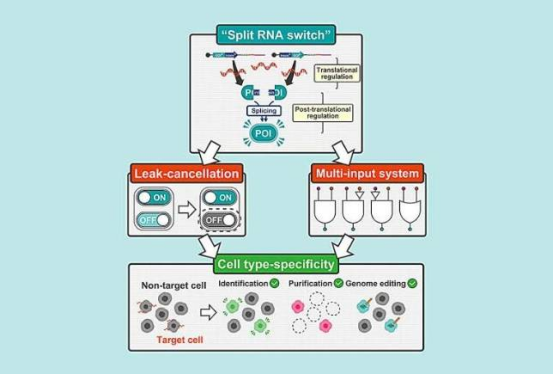
Conventional RNA switches suffer from translation leakage and low signal-to-noise ratios. The team's innovative split RNA switch system uses protein splicing technology to integrate outputs from multiple RNA switches. It employs a split intein design, where a functional protein is formed only when both protein fragments are present simultaneously, dramatically increasing regulatory specificity. Experimental data show the system improves the signal-to-noise ratio of miRNA-responsive switches by more than 25-fold.
Professor Hirohide Saito stated: "This is the first technology to combine mRNA translational control with post-translational protein splicing." The team successfully applied the system to fluorescence imaging, cell sorting, and induced cell death, all demonstrating excellent cell-type-specific control.
In applications with the CRISPR-Cas9 genome editing platform, the system achieved miRNA-dependent precise gene editing in human iPS cells. In a Duchenne muscular dystrophy (DMD) cell model, editing specificity for the dystrophin gene increased 45-fold, effectively reducing off-target effects. The team also constructed multi-input logic gate circuits capable of simultaneously detecting multiple miRNA and protein signals.
This technology provides a new tool platform for gene therapy and regenerative medicine. Its modular design supports expansion across various applications and is expected to advance the development of intelligent RNA therapeutics. The researchers stated that the next step will be to explore the system’s practical value in disease treatment.