
Clean water, the source of life, faces enormous challenges in ensuring its purity in remote or heavily polluted areas. Recently, researchers have successfully developed a breakthrough technology—a compact, battery-free water quality monitoring system that operates using the natural motion of waves, bringing new hope to water quality monitoring.
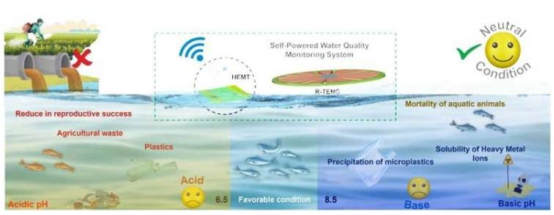
This innovative system integrates two core components. The first is a rotational triboelectric nanogenerator (R-TENG), which captures energy from water movement and converts it into electricity. The collected electrical energy powers a highly sensitive transistor sensor based on AlGaN/GaN materials, known for its stability and outstanding performance in harsh environmental conditions. The related research has been published in the journal Nano Energy.
The sensor boasts remarkable detection accuracy, capable of identifying a variety of harmful substances, including heavy metals (such as lead, arsenic, and chromium), pesticides, and even tiny plastic particles.
The device is housed in a waterproof acrylic shell and driven by magnets, enabling stable continuous operation underwater. Even in high-humidity environments, it generates a stable voltage. It takes approximately 10 seconds to charge a small capacitor, after which it can supply the energy needed for real-time sensor measurements.
In laboratory and real-world river tests, the system demonstrated excellent reliability. It can not only distinguish pollutants at concentrations as low as the nanomolar level but also exhibits a strong linear response to changes in water pH.
Notably, this self-powered sensor requires no batteries or power cables. In traditional monitoring equipment, batteries and power lines often hinder long-term environmental monitoring, whereas this sensor, by harvesting wave energy, enables sustainable, long-term deployment in oceans, rivers, and lakes, strongly supporting ecological protection and public health initiatives.
Professor Tsung-Hung Lin stated: "This compact, self-powered device provides an intelligent solution for remote water quality monitoring and early pollution detection." This innovative achievement is expected to play a significant role in the field of water quality monitoring, promoting the coordinated development of green manufacturing and ecological protection.