
Although most Midwestern farmers practice corn-soybean rotation, commodity prices and corn yield advantages lead some to plant corn continuously. While foundational research on the benefits of corn-soybean rotation dates back decades, scientists at the University of Illinois Urbana-Champaign continue to address the overall picture of crop yield, environmental impact, and economic returns under rotation scenarios.
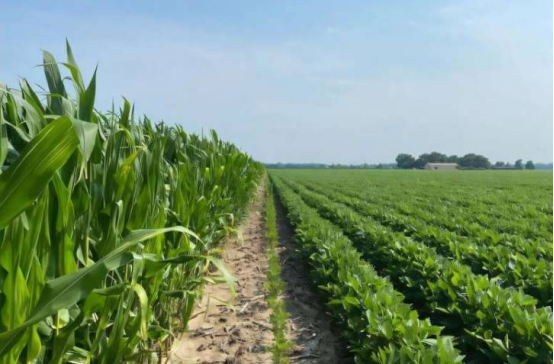
In a new study published in Agriculture, Ecosystems & Environment, researchers from the Agroecosystem Sustainability Center (ASC) and the College of Agricultural, Consumer and Environmental Sciences (ACES) used the sophisticated agroecosystem model "Ecosystem" to explain why corn yields exceed soybean yields at normal nitrogen application rates, how corn-soybean rotation affects soil greenhouse gas emissions and nitrogen leaching, and when rotation is most economically advantageous.
Lead researcher Kaiyu Guan, ASC founding director and Blue Waters Professor in the Department of Natural Resources and Environmental Sciences at ACES, stated that while corn-soybean rotation boosts corn yields and reduces nitrogen fertilizer needs, there are subtle trade-offs for the environment and soil carbon.
Fertilizer Rate Determines Corn Rotation Yield Advantage: The researchers trained the Ecosystem model using a decade of field trial data on different rotations and nitrogen rates from the Department of Crop Sciences. They found that at a standard nitrogen rate (151kg N/ha), corn following soybean yielded on average ~6.4% more than continuous corn. Further analysis revealed that lower biomass and slower soybean residue decomposition leave the soil surface more exposed in spring, warming faster and allowing soil microbes to mineralize more nitrogen from organic matter—providing an early-season nitrogen source for corn seedlings, similar to a starter fertilizer effect, ultimately increasing end-of-season corn yield. However, as nitrogen application increases, this advantage gradually diminishes. First author Ziyuan Li, a research fellow with the American Society of Agronomy, noted that the higher the nitrogen rate, the smaller the yield benefit from rotation, and in some cases the gain nearly disappears.
Rotation Reduces Emissions but Affects Soil Carbon and Nitrogen Loss: Environmentally, corn-soybean rotation helps reduce soil nitrous oxide and ammonia emissions, but rapidly decomposing soybean residues lead to a decrease in total soil organic carbon. Nitrogen leaching is lower in soybean years, yet leaching still occurs under soybeans, highlighting the importance of nitrogen mineralization from organic matter. In the subsequent corn year, nitrogen leaching increases due to soybean stubble decomposition releasing nitrogen into the soil. Professor Guan emphasized that rotation improves some sustainability metrics but impairs others, especially under typical fertilization practices.
Rotation Favors Economic Returns but Depends on Fertilizer Use and Market Prices: Using historical commodity price data, the researchers found that at low nitrogen rates (45lb/acre) and typical market conditions (soybean: $11/bushel, corn: $4.50/bushel, nitrogen: $193/mg [~$175/short ton] UAN), corn-soybean rotation delivered higher economic returns than continuous corn—up to $458/acre ($1,133/ha). However, under high nitrogen inputs and rising corn prices, this advantage significantly weakens or even reverses. Li stated that the degree to which one cropping system outperforms another in net agronomic benefits depends not only on corn yield and nitrogen use but also on soybean yield and market-driven prices, including costs for fertilizer, grain, and machinery. This comprehensive economic assessment helps farmers navigate market volatility and informs insurance products and conservation initiatives.
No One-Size-Fits-All Approach: The study underscores the importance of tailoring nitrogen management to balance profitability and sustainability. Compared to continuous corn, lower fertilization in corn-soybean rotation maximizes economic benefits while mitigating some environmental impacts, but farmers must weigh the potential decline in soil organic matter and increased nutrient loss risks. Co-author Andrew Margenot, associate professor of crop sciences at Illinois, noted that the research provides farmers and policymakers with a more holistic understanding of organic matter, nitrogen, and yield outcomes, and linking these components to show their interconnectedness is key. Given the importance of organic matter as a nitrogen source for crops, the study also highlights the need to consider long-term changes in organic matter.
Decades of research have pointed to the advantages of crop rotation in yield, reduced fertilizer needs, and soil health. This new study provides scientific backing for rotation by rigorously quantifying the agronomic outcomes of corn-soybean rotation, filling knowledge gaps. Although some environmental trade-offs were identified, the economic analysis shows that crop rotation is profitable—especially at lower fertilization rates.