
Over the past few decades, robotics experts have continuously developed advanced systems to enable robots to mimic some human capabilities and handle real-world tasks. To reliably grasp, manipulate, and utilize surrounding objects, robots must possess the ability to detect and process tactile information, replicating the basic processes of human touch.
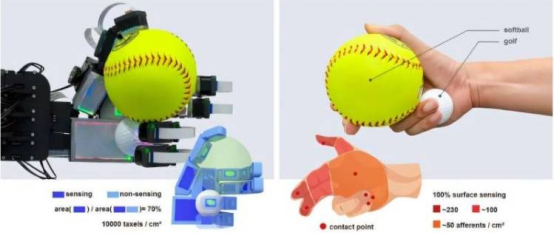
Recently, researchers from Peking University, the Beijing Institute for General Artificial Intelligence, and Queen Mary University of London have achieved a major breakthrough by successfully developing the F-TAC hand—a bionic robotic hand designed to emulate human tactile perception. The related research has been published in Nature Machine Intelligence. This robotic hand collects detailed tactile information to plan movements and trajectories, outperforming all existing robotic hands in tactile manipulation tasks.
Corresponding author Professor Zhu Yixin told Tech Xplore that the research goal is to enable machines to manipulate objects with the same precision and flexibility as humans, drawing inspiration from the complex tactile perception capabilities of the human hand and the specialized neural processing in the primary somatosensory cortex.
Professor Zhu and colleagues focused on developing a new type of robotic hand that seamlessly integrates tactile feedback with sensorimotor mechanisms. Most existing robotic hands cannot achieve this, but the F-TAC hand addresses this gap and demonstrates superior performance across a wide range of real-world manipulation tasks.
The F-TAC hand stands out technically. It integrates 17 high-resolution tactile sensors across 70% of the palm surface, replicating the biological structure of the human hand and achieving a spatial resolution of 0.1mm—equivalent to 10,000 tactile pixels per square centimeter. Its probabilistic algorithms generate diverse, human-like grasping strategies covering 19 common grasp types and can switch strategies in just 100 milliseconds when unexpected situations occur.
To evaluate performance, the research team conducted extensive experiments. In real-world scenarios, the F-TAC bionic hand successfully completed a variety of manual tasks. In 600 real experiments, its success rate for multi-object grasping dramatically increased from 53.5% (for systems lacking tactile feedback) to 100%.
This bionic hand has rich potential application scenarios, including surgical assistance, high-precision assembly, aerospace operations, and emergency response situations requiring exceptional manipulation accuracy.
The initial findings highlight the advantages of the F-TAC hand and contribute to enhancing robots' perception and motor capabilities. In the future, the hand can be further improved and integrated with various humanoid robots, with its potential in specific application domains evaluated through additional experiments. Professor Zhu added that the team plans to continue deepening the fusion of tactile perception and robotic control, exploring more intelligent somatosensory interaction paradigms, advancing embodied intelligence, and contributing to the development of truly general artificial intelligence.