
Population growth, urbanization, and land degradation are placing immense pressure on the global agri-food system. This system encompasses every link in the food supply chain—from crop cultivation in fields to waste treatment or disposal—and is a major source of greenhouse gas emissions, making transformation urgently necessary.
Zhengxia Dou, professor of agricultural systems at the University of Pennsylvania School of Veterinary Medicine, states, "Everyone is part of the global agri-food system because everyone eats—every person is a stakeholder." In her view, food loss and waste are particularly severe issues. Nearly one-third of the food produced for human consumption is lost or wasted before being eaten, threatening food security while wasting land, water, energy, and other resources.
"After meals, people often throw leftovers away just to get them out of sight and mind. But from a resource and environmental perspective, how they are subsequently handled is critical," Dou says. In a recent interview with Penn Today, Dou discussed how to shift away from the current landfill-dominated approach to food waste management to reduce greenhouse gas emissions and better utilize resources, highlighting a study she led that was published earlier this year in Nature Food.
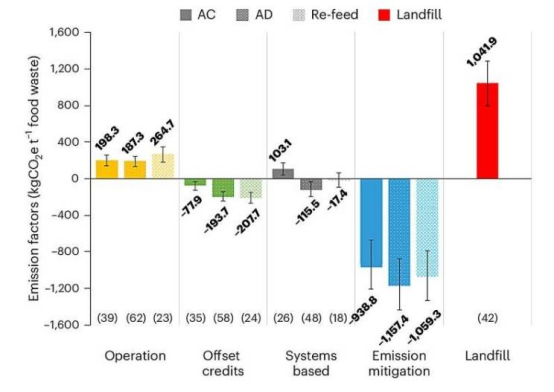
Dou and her co-authors analyzed data from 91 field studies conducted under various conditions across 29 countries, providing "a benchmark for countries developing food waste management strategies within circular agri-food systems."
Composting, Anaerobic Digestion, and Feed Reuse: Three Recovery Methods
The study focused on three food waste recovery methods: composting, anaerobic digestion, and feed reuse. Composting retains nutrients while breaking down organic waste; anaerobic digestion decomposes organic matter to produce biogas (a mixture of methane and carbon dioxide) that can be used as renewable energy; feed reuse repurposes suitable food waste as animal feed. The research evaluated the lifecycle greenhouse gas impacts of these methods.
Results show that recovering food waste through these approaches significantly reduces emissions compared to landfilling. Dou explains that landfills act like "biological amplifiers." Food waste, rich in carbohydrates and other organic compounds, decomposes anaerobically in landfills to produce methane—a greenhouse gas with a 20-year warming potential more than 80 times that of carbon dioxide. "Any method of recovering food waste is better than sending it to a landfill."
Eliminating Landfill Food Waste in Three Major Systems
The United States, European Union, and China have "massive agri-food systems that generate enormous food waste, are major contributors to greenhouse gas emissions and natural resource consumption, and have abundant available data," making them methane "super-emitters" from food waste disposal, according to Dou.
The study modeled a scenario in which food waste originally destined for landfills in these three regions is diverted in a 1:1:1 ratio to composting, anaerobic digestion, and feed reuse to quantify the emissions reduction potential. Calculations show that completely eliminating landfilling would yield substantial greenhouse gas reductions. For example, in the United States, the reduction is estimated to offset methane emissions equivalent to those from nearly 9 million dairy cows—more than 90% of the national dairy herd.
Saving Land, Water, Fuel, and Fertilizer
Dou believes the study's findings on the benefits of feed reuse are the most significant. "I strongly advocate turning suitable food waste into animal feed—it also reduces reliance on conventional feed crops, conserving natural resources and fertilizers."
The research found that if suitable food waste originally bound for landfills in China were recovered through feed reuse, farmland currently used for corn and soybean production could be reduced by more than 5%. The freed land could be repurposed for human food production to enhance food security or retired for conservation. The study also showed that feed reuse can replace large amounts of corn and soybean in animal diets—a particularly important benefit for China and certain EU countries heavily reliant on imported feed.
The study concludes: "Composting food waste, anaerobic digestion, and repurposing it as animal feed are all practical, field-validated, low-cost options that are highly effective at reducing emissions while delivering multiple resource-conservation benefits."
Dou emphasizes that reducing food waste starts at home. "We are all part of the problem, and to solve it, we need to recognize food loss and waste issues and reduce our own environmental footprint by minimizing personal food loss and waste."