
Researchers at Helmholtz Munich have achieved a breakthrough by developing an artificial intelligence model named "Centaur" that simulates human decision-making processes, providing a new tool for understanding human cognition and refining psychological theories. Trained on more than 10 million individual decisions from psychological experiments, Centaur's decision patterns closely resemble those of real humans, enabling it to accurately predict individual behavior choices in both familiar and novel scenarios, and even estimate reaction times.
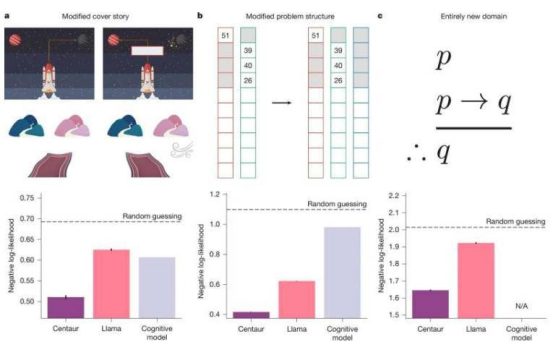
Traditional psychological models have long suffered from two major limitations: difficulty in clearly explaining human thought logic and inability to reliably predict real-world behavior. The team, led by Dr. Marcel Binz and Dr. Eric Schulz from the Helmholtz Institute for Human-Centered Artificial Intelligence, successfully built the Centaur model by integrating the Psych-101 dataset (over 10 million individual decision records from 160 behavioral experiments), creating a model that is both explanatory and predictive. The model not only identifies common decision strategies but also adapts to dynamic environmental changes. Its unique advantage lies in breaking the dependence of classical models on known tasks. Lead author Binz stated: "Centaur can predict human behavior in any scenario described in natural language, such as decision-making processes in virtual laboratories."
In practical applications, the Centaur model opens new perspectives for health research. By simulating individual decision-making in clinical scenarios (e.g., choice patterns of patients with depression or anxiety), the model is expected to reveal differences in decision mechanisms under different psychological states. The team plans to further expand the dataset by incorporating demographic and psychological characteristics to enhance the model's ability to analyze complex cognitive processes. Institute director Schulz emphasized: "We are at the beginning of a paradigm shift in research, and Centaur has already demonstrated enormous potential for interdisciplinary applications." To ensure ethical technology use, the researchers advocate an open, locally hosted model to protect data sovereignty and continue exploring the correspondence between the model's internal computations and actual decision processes.