
A major breakthrough has recently emerged in soil science, as Japanese researchers have developed an innovative method to estimate microbial biomass using water-extractable organic matter (WEOM) from air-dried soil. The related research findings have been published in the journal Soil Discovery.
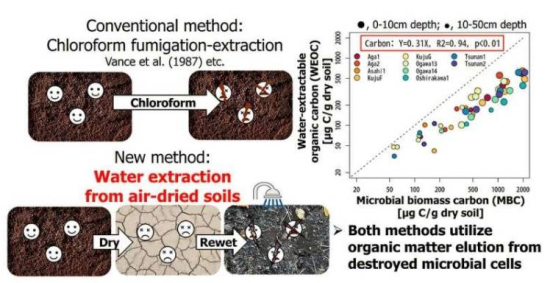
Traditional methods for estimating microbial biomass typically require the use of toxic solvents, such as chloroform fumigation extraction, which are complex and pose risks. In contrast, the new method developed by the Japanese research team not only simplifies the estimation process but also eliminates the need for toxic solvents.
The study was jointly conducted by researchers from Niigata University, Kyushu University, the Japan Atomic Energy Agency, and the Anhui Academy of Agricultural Sciences. The team analyzed 50 soil samples from ten different profiles across various regions in Japan, covering six forests and one pasture, to evaluate the relationship between WEOM measurements and microbial biomass, with particular focus on carbon and nitrogen content.
The results were highly encouraging. The water-extractable organic carbon content obtained from air-dried soil showed an extremely strong correlation with microbial biomass carbon, with a squared correlation coefficient (R²) of 0.94 and a statistical probability (P) less than 0.01, indicating that WEOM can serve as a reliable estimation method for microbial biomass carbon. This holds significant importance for understanding soil health and ecosystem functions. Additionally, the relationship between WEOM and microbial biomass carbon was consistent with soil physicochemical properties, achieving an R² of 1.00 and a root mean square error (RMSE) of only 0.04. However, the correlation between water-extractable total nitrogen and microbial biomass nitrogen was weaker, with R² and RMSE values of 0.73 and 0.28, respectively, due to variations in inorganic nitrogen compounds in soil extracts.
One of the lead researchers, Dr. Hirohiko Nagano, pointed out that the new method allows estimation of microbial biomass using archived air-dried soil samples, even without fresh soil. Moreover, since it does not require toxic substances, the method can be applied in environments where hazardous chemicals are restricted. He also anticipates that this approach could significantly accelerate the construction of large-scale datasets on soil microbial biomass.
Team member Professor Syuntaro Hiradate emphasized that estimating microbial biomass without needing fresh samples or toxic solvents opens new pathways for research in remote or sensitive environments, helping to better understand the role of microorganisms in various ecosystems and providing references for conservation efforts.
Although the authors caution that the method is currently an empirical estimation and requires further validation across different soil samples, its potential to transform the field of soil science is undeniable. Future research is crucial to confirm the method's applicability under diverse soil types and environmental conditions.
This breakthrough represents a significant advancement in soil science, providing researchers with a safer and more efficient tool to study the critical role of microorganisms in soil health and ecosystem dynamics, marking a key moment toward sustainable and effective soil management practices.