
To address the issue of solar power plants sitting idle at night, Sandia National Laboratories scientist John Sandusky is exploring new uses for heliostats. Currently, he is conducting experiments at the National Solar Thermal Test Facility, repurposing heliostats to search for asteroids during nighttime hours.
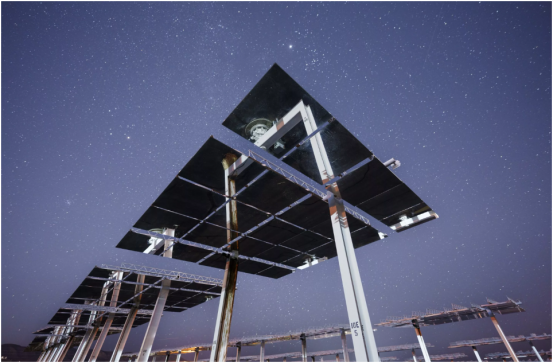
While solar power systems offer many advantages, they cannot operate at night. Once the sun sets, the system shuts down, producing zero electricity until sunrise the next day. This is a practical challenge in both daily life and engineering. Sandusky is testing ways to utilize solar power plants for productive work at night at Sandia's National Solar Thermal Test Facility in Albuquerque, New Mexico.
The facility is the only one of its kind in the United States, consisting of a 61-meter-high concrete tower surrounded by 218 heliostats—mirrors mounted on trackers. These mirrors automatically follow the sun and focus sunlight onto the tower, with a reflective area of 37 square meters capable of generating 6 megawatts of power. However, electricity output drops to zero after sunset.
In fact, heliostats are not limited to tracking the sun; they can be programmed to track other objects. As part of a lab-directed research project, Sandusky has programmed one heliostat to function like a telescope, tracking the night sky and directing reflected energy onto optical instruments on the tower. Although this energy is only in the femtowatt range, by oscillating the heliostat back and forth over a one-minute cycle, conditions suitable for asteroid detection are created.
Traditionally, asteroids are observed using established optical telescopes that capture time-lapse images of the sky over minutes or hours while tracking the stars. In long-exposure images, stars appear as points while asteroids show as streaks, allowing astronomers to determine their presence, distance, size, and orbit. However, the sky is vast and telescopes are limited in number—many asteroids are discovered by amateur astronomers. Today, asteroids represent both potential sources of valuable minerals and threats to Earth, making astronomers eager for more detection tools.
Sandusky's technique does not produce images with visible streaks but captures the photocurrent power spectrum of incident light at sub-millihertz resolution. If an asteroid or spacecraft passes through the field of view, it appears as a frequency shift relative to background starlight, indicating a change in angular motion. Though less visually striking than photographic plate trails, it is sufficient to demonstrate the potential of repurposing idle solar power facilities as low-cost supplements to NASA's Asteroid Terrestrial-impact Last Alert System (ATLAS), which aims to detect potentially hazardous asteroids. According to Sandusky, the technology could also have military applications, helping defense agencies detect spacecraft operating covertly in cislunar space—though it would need further development to reach practical levels.
Sandusky stated: "We are looking for opportunities to scale from one heliostat to multiple, proving it can help find near-Earth objects, and we want to show the technology can be scaled to detect smaller asteroids." The research findings have been presented at a conference of the International Society for Optics and Photonics.