
Astronomers have recently announced the discovery of an astonishingly massive black hole, with a mass approaching the theoretical limit for the universe and 10,000 times heavier than the black hole at the center of the Milky Way. This cosmic behemoth resides in the Cosmic Horseshoe galaxy, a massive system that warps spacetime, bending light from a background galaxy into a giant horseshoe-shaped Einstein ring. The newly discovered black hole has a mass equivalent to 36 billion solar masses, making it one of the ten most massive black holes ever found—and very likely the most massive.
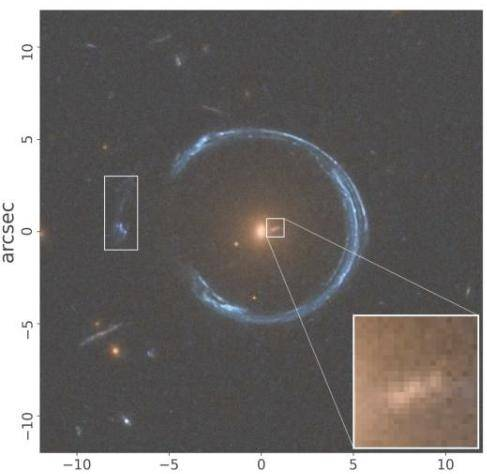
Professor Thomas Collett, a researcher at the University of Portsmouth, stated: "Most other black hole mass measurements rely on indirect methods with large uncertainties. Our new method combines gravitational lensing and stellar kinematics, providing greater certainty in black hole mass measurements." Stellar kinematics is considered the gold standard for measuring black hole masses, but it is difficult to apply in the distant universe because galaxies appear too small. The addition of gravitational lensing allows the research team to "probe further into the universe," detecting the black hole's influence through both altered light paths and high-speed stellar motions (approaching 400km/s).
Lead researcher Dr. Carlos Melo, a PhD student at the Federal University of Rio Grande do Sul in Brazil, noted that this discovery targets a "dormant" black hole—one not actively accreting matter during observation. Its detection relies entirely on the black hole's immense gravity and its effects on the surrounding environment. Melo emphasized: "Our method combines strong lensing with stellar dynamics, providing more direct and robust measurements even for distant systems." This discovery will help astronomers understand the relationship between supermassive black holes and their host galaxies, revealing the mystery of their closely correlated sizes.