
Researchers from Sorbonne University have developed a novel quantum field theory (QFT) simulator that manipulates polariton fluids to simulate curved spacetime features in a laboratory environment, providing an experimental platform for verifying quantum mechanical effects such as Hawking radiation. The findings have been published in Physical Review Letters, with the core innovation lying in using quasiparticles—polaritons—generated by strong interactions between photons and excitons to construct a one-dimensional quantum fluid system, enabling controllable simulation of black hole horizon geometry.
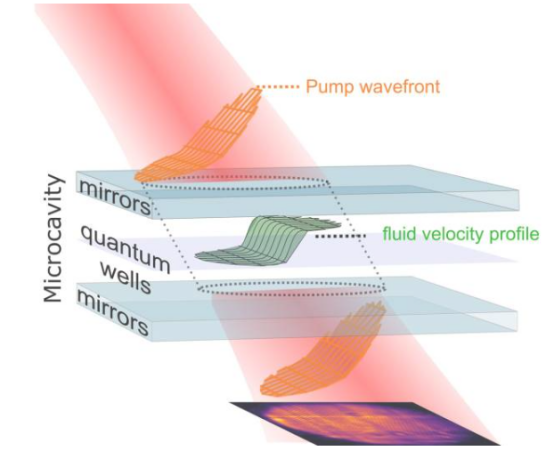
The research team optimized experimental conditions through numerical simulations, successfully creating a horizon in the polariton fluid and measuring spectral features of the quantum field inside and outside the horizon. First author Kevin Falque noted: "The experiment confirms that the synergy between dispersion and the Doppler effect can generate negative-energy waves inside the horizon—a key mechanism of the Hawking effect." Team leader Alberto Bramati emphasized that the system's all-optical control characteristics allow researchers to flexibly adjust horizon geometric parameters, including the degree of spacetime deformation and horizon steepness, thereby enhancing the observability of the Hawking effect.
This breakthrough advancement enables theoretical physicists to test QFT predictions in a controllable environment. Co-senior author Maxime J. Jacquet stated: "The spectral resolution achieved in the experiment reaches unprecedented levels, laying the foundation for studying the frequency dependence of the Hawking effect." Future research will focus on measuring quantum entanglement produced by Hawking radiation and exploring the impact of amplification phenomena in rotating black hole geometries on entangled states. The tunability of this platform provides a new paradigm for studying the response of modified spacetime microstructures to the Hawking effect.