
In collaboration with the Max Planck Institute for Solid State Research, researchers from the University of Stuttgart have published a novel method for constructing DNA-based moiré superlattices in Nature Nanotechnology. This technology achieves precise nanoscale control through DNA self-assembly, opening new pathways for functional material design.
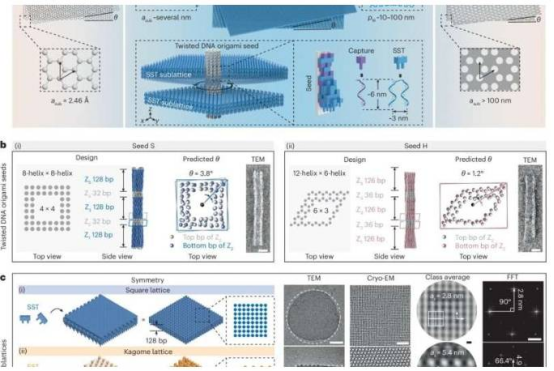
The research team innovatively combined DNA origami with single-stranded tile assembly techniques to develop a "nucleation seed"-guided self-assembly process. Project leader Professor Na Liu stated: "Unlike traditional mechanical stacking methods, our technology directly encodes geometric parameters into the DNA molecular design." Experiments confirmed that the method can construct superlattice structures with unit cell sizes as small as 2.2 nanometers and achieve precise control of twist angles.
The technology demonstrates multifaceted application potential. Professor Peter A. van Aken from the Max Planck Institute noted: "These structures can serve as scaffolds for nano-components, holding significant value in fields such as photonics and spintronics." The research team has successfully prepared moiré superlattices with gradient variations, providing possibilities for the development of novel functional materials.